
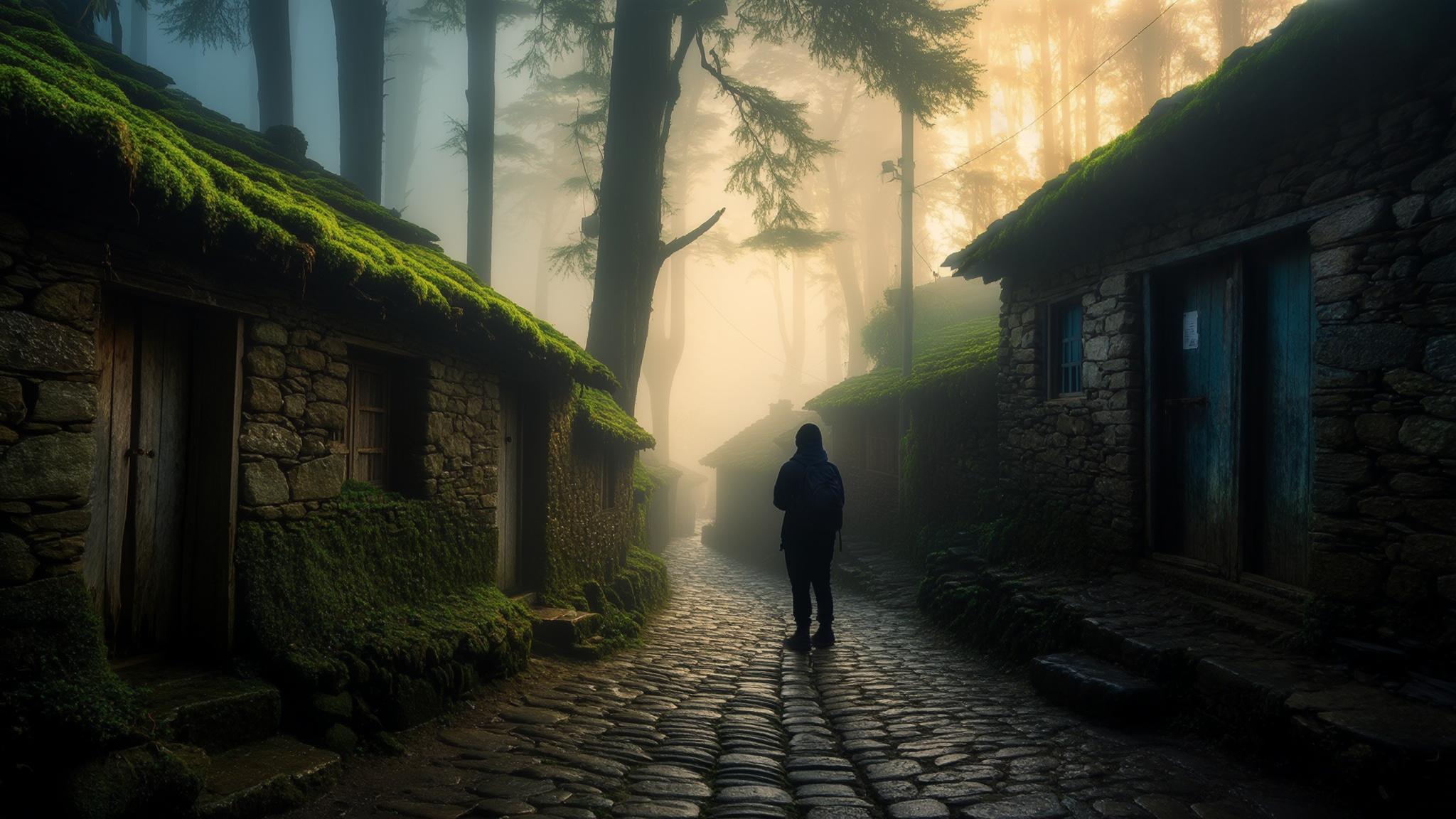
Have you ever returned from a hill station and felt, somewhere on the drive back, that you missed the actual place? That the crowds, the cable cars, and the identical souvenir stalls were a layer of noise between you and something quieter — something that would have required just a little more effort to find? If Mussoorie is on your travel list for 2026, that feeling has a specific cure, and it starts at a fork in the road just past the Picture Palace chowk.
Landour — pronounced lan-DOW-er, often mispronounced, frequently skipped — sits at approximately 2,275 metres above sea level, making it the highest permanently inhabited neighbourhood in the Mussoorie region. It is a former British military cantonment, a working Cantonment Board area, and home to roughly 4,000 permanent residents. It is also, by almost every measure that matters to a thoughtful traveller, more interesting than the stretch of Mall Road that most tourists never leave.
What Landour Actually Is — And Why It Exists
Landour’s identity cannot be separated from its military history. The British established a convalescent depot here in the 1820s, using the higher altitude and cooler air to help soldiers recover from the lowland heat. The Cantonment Board that governs Landour today is one of the oldest such boards in India, and it shows — the roads are surprisingly well-maintained by hill-station standards, the building bylaws are stricter, and the overall density of construction is dramatically lower than Mussoorie proper.
The result is a neighbourhood that feels structurally different from the rest of the hill town. Stone walls run alongside narrow walking paths. Deodar cedars grow tall enough to block out the sky in patches. Old missionary schools, churches, and colonial bungalows sit behind iron gates, many of them still in private use. The Uttarakhand Tourism website lists Landour as a point of interest, but does not quite capture what it feels like to walk through it on a clear morning in April or October.
For Indian travellers who grew up reading Ruskin Bond — and that is a significant portion of the domestic market — Landour carries an additional layer of meaning. Bond has lived in the neighbourhood for decades, in a small house called Ivy Cottage on Landour’s upper circuit. He is occasionally spotted at Char Dukan, the cluster of four tea stalls at the top of the bazaar road that has become the most photographed spot in the area. The literary connection is real, not manufactured for tourism.
The Landour Circuit: Distances, Duration, and What You Will Actually See
The standard Landour walking circuit — known locally as the Landour Chukkar — is approximately 5 kilometres end to end if you start from Picture Palace and loop back via Sisters Bazaar. Budget three to four hours if you plan to stop, which you will. The elevation gain from the Picture Palace chowk to Lal Tibba, the highest viewpoint at 2,275 metres, is roughly 200 metres over two kilometres of gradual climb.
The walk breaks naturally into three sections, each with a distinct character:
- Char Dukan (Four Shops): The social heart of upper Landour. Four tea and snack stalls have operated here for generations, serving chai (approximately ₹30–40 per cup in 2025–26), Maggi noodles, and local baked goods. On weekday mornings, the clientele is almost entirely local residents. On weekend afternoons, there is a gentle tourist presence.
- Lal Tibba: The highest point accessible to casual walkers. On clear days — most days between October and early June — the view takes in Bandarpoonch, Kedarnath, and on exceptional days, Chaukhamba in the far distance. There is a small telescope here; the caretaker charges approximately ₹20 for a look.
- Sisters Bazaar: A small market stretch named after the Christian Sisters who once ran a hospital nearby. This is where the old Prakash’s Store, known for its English-style baked goods, is located. The store has been there since the 1940s and remains a reliable stop for walkers coming down from Lal Tibba.
Landour vs. Mall Road: An Honest Comparison for Different Types of Travellers
Choosing how to divide your time between Mall Road and Landour depends on what you actually want from a hill-station trip. Neither is objectively better — they serve different purposes and attract different energies. The problem is that most travellers default to Mall Road entirely because it is where the hotel recommendations cluster and where the cabs drop you.
Mall Road delivers efficiency: food, shopping, views from the promenade, cable car access to Gun Hill, and the social density that some travellers genuinely enjoy. On a one-night trip, it is the practical choice. Landour delivers something slower — walks with actual silence between footsteps, chai that costs less than a bottled water, architecture that has not been plastered over in the last decade, and the particular pleasure of being in a place that requires a small amount of effort to reach.
Practical Planning: Getting There, Costs, and the Right Season
Mussoorie sits approximately 290 kilometres from Delhi via the Dehradun expressway — a drive of five to six hours under normal traffic conditions. Dehradun itself is 35 kilometres and roughly one hour from Mussoorie by road. The nearest railway station is Dehradun, which is well-connected to Delhi, Lucknow, and Mumbai. From Dehradun, shared cabs to Mussoorie run throughout the day and cost approximately ₹150–200 per person.
From Mussoorie’s main taxi stand near the Library chowk, a hired cab to the Landour Chukkar starting point (Picture Palace) costs around ₹150–200 for the short uphill stretch. Many hotels on the Camel’s Back Road side are already closer to Landour’s entry point and walkable. If you are staying near Kulri Bazaar or Library end, factor in the uphill walk or the cab cost.
On the question of timing, April and May are excellent months for Landour specifically. The rhododendrons are in bloom on the lower slopes, the Himalayan views are still sharp before the pre-monsoon haze builds in late May, and the crowds — while present — have not yet reached the May long weekend peaks. October and November after the monsoon are the other ideal window: the air is exceptionally clear, temperatures in Landour at this altitude drop to around 5–8°C at night, and the post-monsoon greenery is at its fullest.
What Is Changing — And What Landour Is Doing to Stay the Same
Landour’s Cantonment Board status has historically been its single most effective preservation tool. The same bureaucratic structure that frustrates visitors who want to drive everywhere is also the reason the upper neighbourhood has not been commercialised at the same pace as Mussoorie. New construction requires Cantonment Board approval, and the board has been conservative about large-scale commercial development.
That said, the neighbourhood is not entirely static. The number of homestays in Landour has increased noticeably since 2020, with several colonial-era bungalows converted to small guesthouses charging between ₹2,500 and ₹6,000 per night. The quality varies significantly — some offer genuinely atmospheric stays in century-old buildings, while others are standard rooms in old shells. Reading recent reviews carefully before booking is essential. The Uttarakhand Tourism Development Board has also been promoting Landour as part of its heritage tourism initiatives, which brings both visibility and the accompanying footfall.
The tension that Landour navigates — between remaining a functioning, quiet residential neighbourhood and absorbing the interest of a growing domestic travel market — is one that every characterful Indian hill destination faces. For now, the balance holds. The morning walk to Char Dukan still feels like something you found, not something you were sold.
The Bottom Line for Your 2026 Mussoorie Trip
If you are planning a Mussoorie trip this year and you have at least two nights, Landour deserves half a day of your itinerary — ideally your first morning, before the day settles into the familiar rhythm of mall walks and cable car queues. The walk costs almost nothing. The view from Lal Tibba on a clear April morning is among the more extraordinary things you can see from a paved path in the Garhwal Himalayas. And the chai at Char Dukan, in a setting that has barely changed in decades, is the kind of experience that earns a second trip.
Mussoorie is not a secret, and Landour is not one either. But the gap between knowing it exists and actually walking up there is where most day-trippers fall away. Close that gap, and the hill town reveals a version of itself that the Instagram grids rarely capture.