
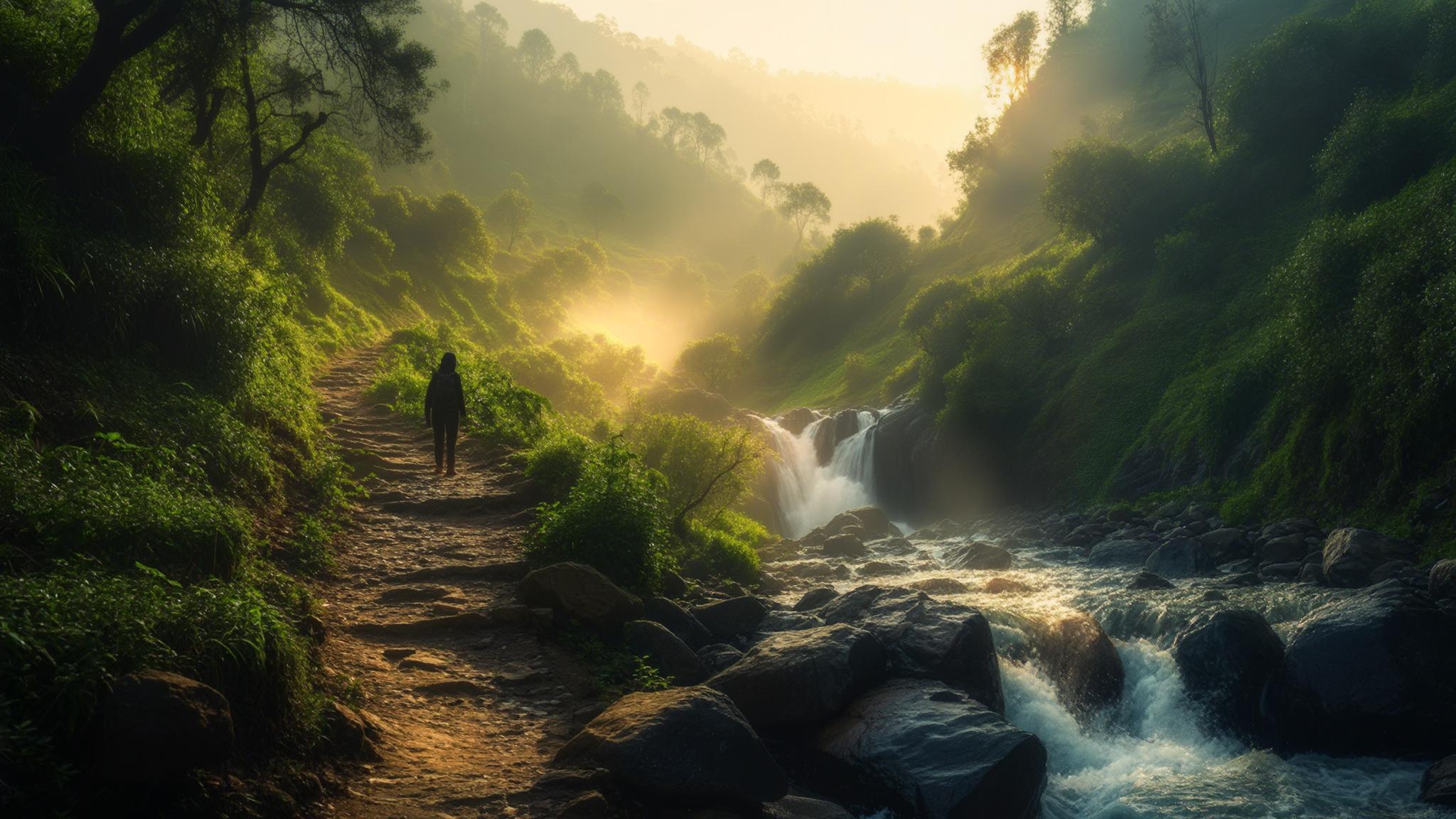
When did you last choose the harder path — not because it was scenic or Instagrammable, but simply because almost nobody else was on it? That instinct, more than any guidebook recommendation, is what keeps Mussoorie’s western ridge trails intact and genuinely worth walking in 2026.
While the hill station’s headline attractions — Kempty Falls, Gun Hill, Mall Road — absorb hundreds of visitors daily during peak season, a trail system running west from Benog Wildlife Sanctuary toward the ruins of Childer Lodge passes three distinct waterfalls and a stretch of mixed oak-rhododendron forest that sees, by conservative local estimate, fewer than thirty walkers on a busy Sunday. The route is not secret. It is simply overlooked.
What the Trail Actually Covers — and What It Does Not
The trail begins at the Benog Wildlife Sanctuary gate on Benog Hill, roughly 11 kilometres from Mussoorie’s Library Bus Stand by road. The sanctuary itself charges a nominal entry fee of ₹50 per adult as of early 2026, according to signage at the gate confirmed by visitors in March 2026. Children under twelve enter free.
From the gate, the main forest path climbs steadily for the first two kilometres before levelling onto the ridge proper. The first waterfall — a 15-to-20-metre drop known locally as Chham Chham falls, though it appears on no official map under that name — is visible from a clearing approximately 2.4 kilometres in. Seasonal flow is strongest between mid-July and late September, when it can be heard before it is seen.
The second and third water features are smaller — cascades rather than falls — located at roughly the 4-kilometre and 6.5-kilometre marks respectively. Both cross the path directly, meaning boots will get wet on a post-rain day. Waterproof footwear is advisable rather than optional.
The Childer Lodge Ruins — What Remains and Why
At approximately the 7-kilometre mark, the trail opens onto a flat clearing where the stonework foundations and partial walls of Childer Lodge are still visible. The structure dates to the British colonial period — local historians in Mussoorie place its construction in the late nineteenth century, when it served as a rest house for officers travelling the western Doon valley ridge routes.
The Mussoorie Heritage Society, a voluntary documentation group active since 2018, has catalogued the site as one of seventeen colonial-era rest house remnants within a 20-kilometre radius of Mall Road. According to the Society’s publicly available documentation, Childer Lodge was abandoned sometime after Indian independence and was never formally transferred to state heritage protection, leaving it in its current unrestored state.
The clearing around the ruins offers unobstructed views north toward the Bandarpunch massif on clear days. Morning visits in winter — January through early March — reportedly produce the clearest Himalayan sightlines, though the trail can be muddy and occasionally icy near the second cascade during those months.
Practical Costs and Logistics Broken Down
Budget-conscious travellers will find this one of Mussoorie’s most cost-effective half-day activities. The full cost breakdown for a solo walker is straightforward.
Shared cabs from Library Bus Stand to Benog run throughout the morning and charge approximately ₹100–₹140 per seat depending on season and negotiation. A private cab will cost ₹350–₹500 one-way. No food vendors operate inside the sanctuary, so carrying water and snacks from town is necessary. A tea stall just outside the sanctuary gate — run by a family who have operated at that location for over a decade according to regular visitors — sells chai for ₹15 and Maggi for ₹40.
- Entry fee: ₹50 per adult (children under 12 free)
- Shared cab from Library Stand: ₹100–₹140 per seat
- Water (carry from town): minimum 1.5 litres recommended
- Trail permit: none required for day visitors
- Guided walk option: available through Mussoorie Trek Club at approximately ₹400 per person, groups of four or more
Best Season and What Changes Month to Month
The trail is walkable year-round, but the experience shifts considerably with the season. Each window offers a different reason to visit — none of them wrong, depending on what a visitor is looking for.
According to local trekking guide Priya Negi, who has been leading walks in the Mussoorie range for seven years, the October window draws a small but loyal group of repeat visitors. “October after the rains is when the hills smell different,” Negi told NPP Mussoorie in March 2026. “The waterfalls are still running, the leeches are gone, and you can see Bandarpunch if the morning is clear. That combination doesn’t last long.”
How This Trail Compares to Mussoorie’s Better-Known Walks
Mussoorie offers several established walking routes, but they vary significantly in crowd density, cost, and the kind of experience they deliver. The table below draws on publicly available information and on-ground visitor accounts gathered in early 2026.
The contrast with Kempty Falls is stark. Kempty, Mussoorie’s most-visited natural attraction, draws thousands of visitors on peak weekends — a figure cited by the Uttarakhand Tourism Development Board in its 2024 visitor data reports. The infrastructure around Kempty has grown to match that volume, with food stalls, changing rooms, and a commercial zone that many travellers find diminishes the waterfall experience itself.
The Benog trail offers the inverse: less infrastructure, fewer people, a longer walk, and a destination — the Childer Lodge ruins — that rewards curiosity rather than a quick photograph and departure.
What Travellers Should Know Before They Go
A few practical points matter more than most travel coverage acknowledges. The sanctuary gate opens at 7:00 AM and closes at 5:30 PM according to posted hours confirmed in March 2026. Mobile connectivity drops to zero or near-zero inside the sanctuary beyond the first kilometre — download an offline map before entering.
The trail is not marked with consistent signage beyond the first 1.5 kilometres. First-time walkers are strongly advised to either hire a guide through the Mussoorie Trek Club (reachable via their listed contact at the Kulri market office) or go with someone who has completed the route before. The path is well-worn and not technically difficult, but junctions without signs have caused day-trippers to lose significant time on wrong forks.
- Carry minimum 1.5 litres of water — no refill points inside the sanctuary
- Download offline maps before entry (connectivity drops within 1 km of gate)
- Leech socks recommended July through September
- Waterproof footwear advised outside of May and June
- Start by 10:00 AM for a comfortable full-route return before closing
- Guided walks available through Mussoorie Trek Club at approximately ₹400 per person
The trail does not require any advance booking, permit application, or registration for individual day visitors. Groups of more than twenty people are technically required to inform the sanctuary office in advance, though enforcement of this rule appears inconsistent based on local accounts.
For a hill station that has spent decades building its identity around accessible, crowd-friendly tourism, this western ridge route represents something different — a walk that asks a little more of the visitor and returns considerably more in kind.