
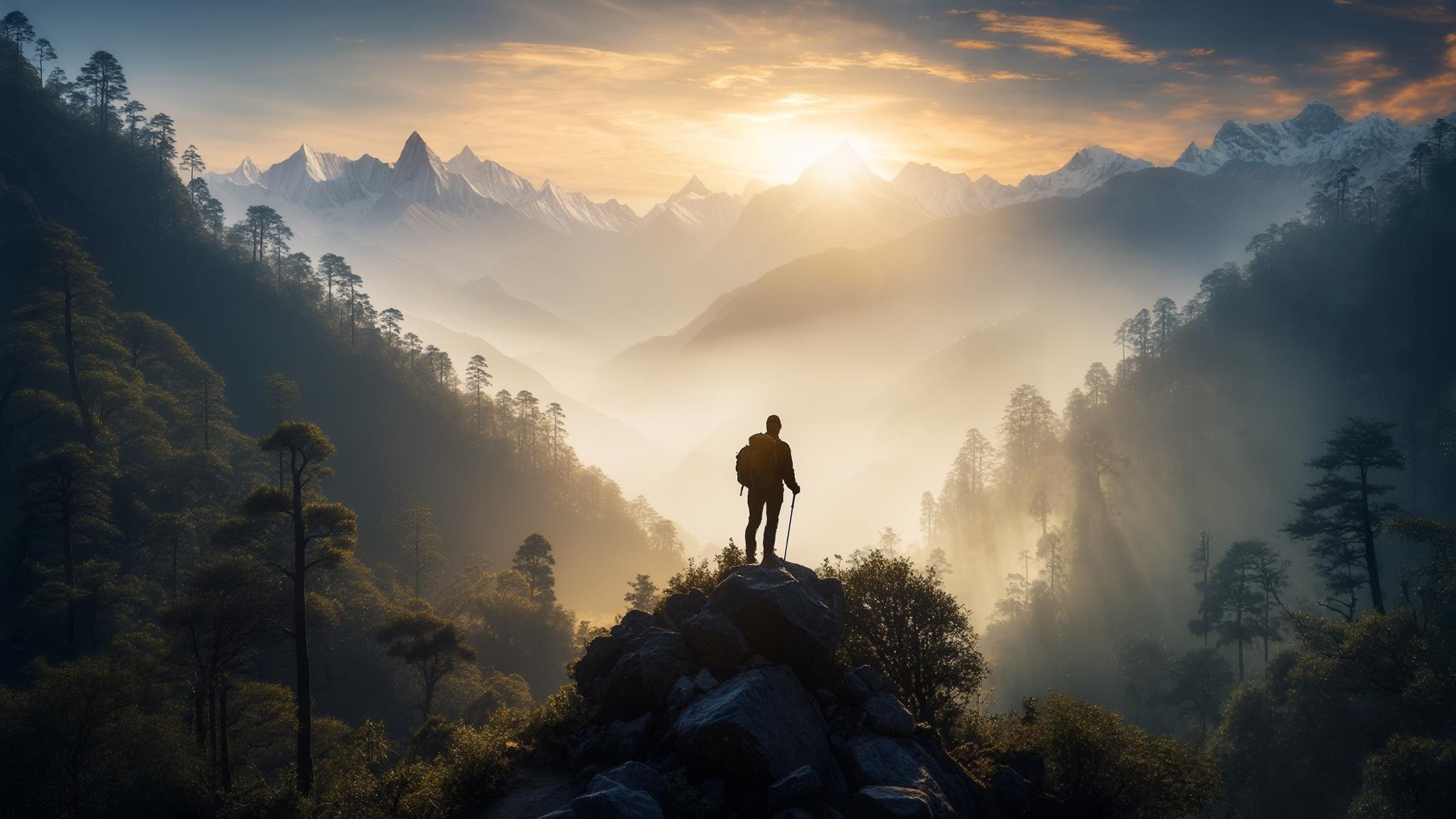
Approximately 95 percent of the roughly 1.5 million annual visitors to Mussoorie, according to estimates from the Uttarakhand Tourism Development Board, never walk more than 500 metres from a motorable road. That statistic is what makes the George Everest Peak trail — a 6-kilometre round-trip ridge walk beginning at Park Estate — one of the most rewarding and underused day hikes in the Garhwal foothills.
Where the Trail Starts and How to Get There
The trailhead begins at Park Estate, a locality approximately 6 km west of Mussoorie’s Library Chowk along the Char Dukan road. Shared cabs from Library Chowk cover the distance for roughly ₹30–50 per seat; private taxis quoted at ₹300–400 one-way as of early 2026, according to local cab aggregator listings on the Mussoorie taxi union board.
From Park Estate, a dirt path climbs steadily through oak and rhododendron forest before opening onto the exposed ridge that leads to the summit ruins. The trail is unmarked in several sections but well-worn; local guides from Mussoorie’s registered trekking operators — including Himalayan Treks Mussoorie and Nature Trails Uttarakhand — charge approximately ₹400–600 for a half-day guided walk as of March 2026.
What Survives at the Summit — and What the History Actually Means
Sir George Everest served as Surveyor General of India from 1830 to 1843 and used the estate at this ridgeline location as a working observatory and rest house during the Great Trigonometrical Survey of India. The survey, one of the most ambitious cartographic projects in recorded history, produced the measurements that eventually allowed Andrew Waugh — Everest’s successor — to calculate the height of Peak XV in the Himalayas. The mountain was subsequently named after Everest in 1865, according to the Survey of India’s official historical records.
What remains at the summit today consists of two stone structures: the main house, which retains partial walls and a recognisable floor plan, and a smaller laboratory building to the northeast. The Archaeological Survey of India has classified the estate as a protected monument, though active conservation work on the site has been intermittent, according to local heritage documentation compiled by the Mussoorie Heritage Centre.
From the summit, the panorama spans roughly 270 degrees on a clear day, taking in the Aglar river valley to the south, the Doon Valley and Dehradun city to the southeast, and the high Garhwal peaks — including Bandarpunch (6,316 m) and the Swargarohini massif — to the northeast. A small government-installed plaque at the ruins provides basic biographical details about Everest, though heritage advocates have noted publicly that the interpretive signage is insufficient given the site’s global significance.
Best Season, Weather Windows, and What to Pack
The trail is accessible year-round, but conditions vary substantially by month. March through June offers the clearest mountain views and moderate temperatures at the ridgeline, typically between 8°C and 18°C during daylight hours. The monsoon season — July through mid-September — makes the path slippery and obscures the Himalayan panorama; walkers who visit during this period should expect reduced visibility and muddy trail conditions.
October through November is considered the second-best window: post-monsoon clarity can produce exceptional Himalayan views, and daytime temperatures remain comfortable. Winter months (December through February) see snowfall on the ridge, which adds visual drama but requires ankle-supporting footwear and awareness that the path may be icy in morning hours.
A standard packing list for the half-day walk includes:
- Sturdy walking shoes or low-cut trekking boots (trail surface is uneven rock and compacted soil)
- At least 1.5 litres of water per person — no reliable water source exists on the route
- Light snacks; the nearest food stall is at Char Dukan, approximately 1.5 km from the trailhead
- Sunscreen and a hat — the exposed ridgeline section offers no shade for roughly 1.5 km
- A fully charged mobile phone; cellular coverage on the ridge is variable but generally available on BSNL and Jio networks
Cost Breakdown and How to Book a Guide
For independent walkers arriving from Mussoorie town, the total expenditure is modest. A shared cab from Library Chowk to Park Estate costs approximately ₹30–50 per seat. There is no formal entry fee for the ASI-protected monument as of March 2026, though a small voluntary donation box maintained by a local conservation group is present at the site.
Guides can be booked through the Mussoorie Tourism Office near Library Chowk or directly via registered operators including Nature Trails Uttarakhand. The Uttarakhand Tourism Development Board maintains a list of licensed guides on its official portal at uttarakhandtourism.gov.in, though travellers should verify availability at least 24 hours in advance during peak season (April–June and October).
What Heritage Advocates Say Needs to Change
Several Mussoorie-based heritage and tourism voices have publicly argued that the George Everest estate is significantly undersupported relative to its historical importance. The Mussoorie Heritage Centre, a local documentation project, submitted a proposal to the Uttarakhand state government in 2024 requesting improved trail signage, a small on-site interpretive panel, and a formal car park at Park Estate to reduce roadside congestion during peak season.
As of March 2026, that proposal has not received a formal public response from the state tourism ministry, according to Heritage Centre representatives. The Archaeological Survey of India’s Dehradun circle, which administers the protected monument, confirmed in a 2024 public notice that routine structural assessment of the ruins had been completed, but did not specify a timeline for conservation or visitor infrastructure work.
Despite the infrastructure gap, footfall on the trail has grown steadily, according to guide associations in Mussoorie, who estimate that guided bookings for the George Everest route increased by approximately 30 percent between 2023 and 2025 — driven in part by social media coverage from trekking communities on platforms including Reddit’s r/IndiaTravel and local Instagram travel accounts.