
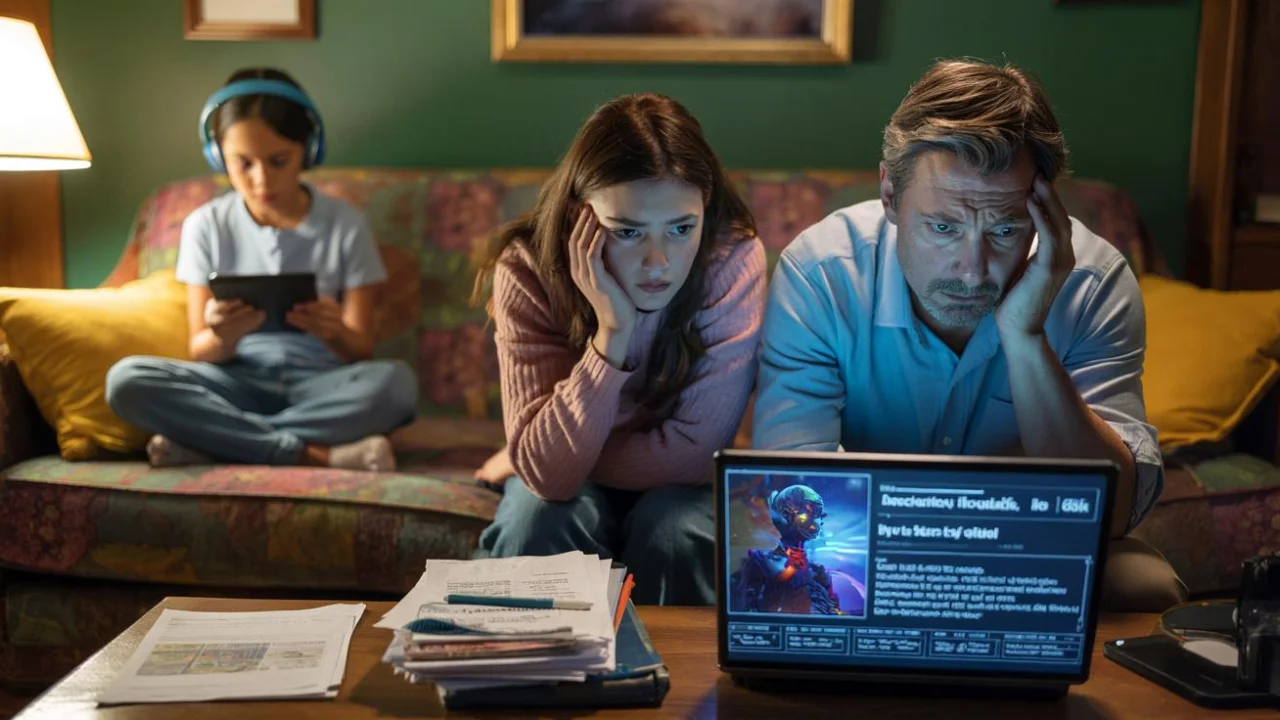
Sarah watches her 16-year-old daughter Emma create digital art on her tablet, fingers dancing across the screen with practiced precision. The artwork is stunning – vibrant landscapes that seem to breathe with life. But as Sarah scrolls through her phone later that evening, she stumbles across an article about AI generating professional-quality artwork in seconds. Her heart sinks.
She closes her eyes and remembers her own mother’s voice: “Get a safe job, something stable.” Now Sarah finds herself facing an impossible question: should she crush her daughter’s artistic dreams to push her toward AI-resistant careers, or let her pursue a passion that machines might soon dominate?
This internal battle is playing out in homes across the globe as parents grapple with an unprecedented dilemma – how to guide their children in an age where artificial intelligence threatens to reshape the very concept of work and creativity.
The New Parental Nightmare: When Dreams Meet Algorithms
Parents children AI discussions have become dinner table fixtures in countless households. The conversation usually starts innocently enough. Your child mentions wanting to be a graphic designer, writer, or musician. You smile and nod, but internally, you’re calculating whether these careers will even exist in ten years.
The statistics are sobering. AI can now write marketing copy, compose music, create logos, and even code simple applications. Parents find themselves caught between wanting to support their children’s passions and the primal need to ensure their economic survival.
“I watch my son spend hours perfecting his photography, and part of me wants to tell him to study plumbing instead,” says Mark Chen, a father of two from Portland. “At least pipes will always need fixing, right?”
But the reality is more complex than simply steering kids away from “AI-vulnerable” careers. The technology is advancing so rapidly that even supposedly safe jobs are showing cracks in their armor.
Which Careers Are Actually Safe? The Truth Might Surprise You
The common wisdom suggests pushing children toward healthcare, skilled trades, or STEM fields. But even these “safe havens” are experiencing AI disruption:
| Career Field | AI Impact Level | Key Changes |
|---|---|---|
| Healthcare | Medium | AI diagnostics, automated pharmacy, robot surgery assistance |
| Skilled Trades | Low-Medium | Automated design tools, robotic construction equipment |
| Creative Fields | High | AI art, music composition, content writing |
| Legal/Finance | Medium-High | Document review, basic contract drafting, financial analysis |
| Education | Medium | AI tutoring, automated grading, personalized learning |
The careers showing the most resilience share common characteristics:
- High emotional intelligence requirements
- Complex problem-solving involving human judgment
- Physical dexterity in unpredictable environments
- Creative collaboration and leadership
- Ethical decision-making under pressure
“The jobs that will survive are the ones that require uniquely human skills,” explains Dr. Rebecca Martinez, a workforce development researcher. “But here’s the catch – those same skills can make any profession more AI-resistant.”
The Real Question: Resistance or Collaboration?
Many parents are asking the wrong question entirely. Instead of “How do I keep my child away from AI?” the focus should be “How do I help my child work alongside AI?”
Consider this: the most successful artists today aren’t those avoiding digital tools, but those mastering them while maintaining their creative vision. The same principle applies across industries.
Take coding, often cited as an AI-proof career. AI can now generate basic code, but it still needs human programmers to define problems, architect solutions, and ensure quality. The role is evolving, not disappearing.
“I initially panicked when AI started writing code,” admits Jennifer Walsh, a software engineer and mother. “Then I realized it just made me more productive. Now I teach my kids to see AI as a powerful tool, not a threat.”
The key insight: children who learn to leverage AI early will have significant advantages over those who fear or avoid it.
What Smart Parents Are Actually Doing
Rather than forcing career pivots, forward-thinking parents are taking a different approach. They’re focusing on developing their children’s uniquely human capabilities while ensuring AI literacy.
Lisa Thompson, whose daughter wants to be a journalist, didn’t discourage the dream. Instead, she enrolled her in coding classes and encouraged her to experiment with AI writing tools. “She’s learning how to fact-check AI, how to add human insight that machines can’t provide,” Thompson explains.
The most effective strategies include:
- Teaching critical thinking about AI outputs
- Encouraging experimentation with AI tools
- Developing strong communication and leadership skills
- Fostering creativity and original thinking
- Building emotional intelligence and empathy
Parents are also having honest conversations about adaptation. “I tell my kids that whatever career they choose, it will probably change dramatically during their lifetime,” says David Kim, father of three. “The goal isn’t to pick the perfect job, it’s to become someone who can learn and adapt.”
The Mental Health Factor Nobody Talks About
Pushing children away from their passions carries hidden costs. Career counselors report increasing anxiety among teenagers whose parents pressure them into “AI-safe” fields they hate.
“I see kids who are miserable in pre-med programs because their parents fear their love of music won’t pay the bills,” says Dr. Amanda Foster, a high school counselor. “But passion and adaptability often matter more than the specific field.”
The pressure is creating a generation caught between their dreams and their parents’ fears. Some are rebelling entirely, while others are developing anxiety disorders from the constant worry about their future relevance.
Mental health professionals emphasize that children who pursue their interests with proper guidance often find ways to adapt and thrive, while those forced into unwanted careers may struggle regardless of job security.
Building an AI-Ready Mindset Instead of AI-Avoidant Careers
The most resilient approach focuses on mindset over specific career paths. Parents who successfully navigate this challenge teach their children to view AI as a collaborative partner rather than a replacement threat.
This means encouraging curiosity about how AI works, promoting ethical thinking about its applications, and developing the interpersonal skills that remain uniquely human. Children learn to ask: “How can this tool help me do better work?” rather than “Will this tool replace me?”
“My daughter still wants to be an artist,” says Maria Rodriguez, whose story echoes many parents’ journeys. “But now she’s also learning 3D modeling, understanding how AI art generators work, and developing her unique style that incorporates these tools. She’s not running from the future – she’s preparing to lead it.”
FAQs
Should I discourage my child from pursuing creative careers because of AI?
Not necessarily. Focus on helping them understand how to work with AI tools while developing their unique creative voice and business skills.
Which jobs are completely safe from AI replacement?
No job is completely safe, but roles requiring complex human judgment, emotional intelligence, and unpredictable problem-solving show the most resilience.
How early should children start learning about AI?
Children can begin understanding AI concepts as early as elementary school through age-appropriate games and activities, with more technical education starting in middle school.
Is it wrong to push my child toward STEM fields for job security?
Encourage STEM literacy, but forcing a child into a field they hate can backfire. Focus on developing adaptable skills regardless of their chosen path.
How do I talk to my child about AI without scaring them?
Frame AI as a powerful tool they can learn to use rather than a threat. Focus on the exciting possibilities while teaching critical thinking about its limitations.
Should my child learn to code even if they want to be an artist?
Basic coding literacy helps children understand how digital tools work and can enhance creativity in any field, but it shouldn’t replace their primary interests.