
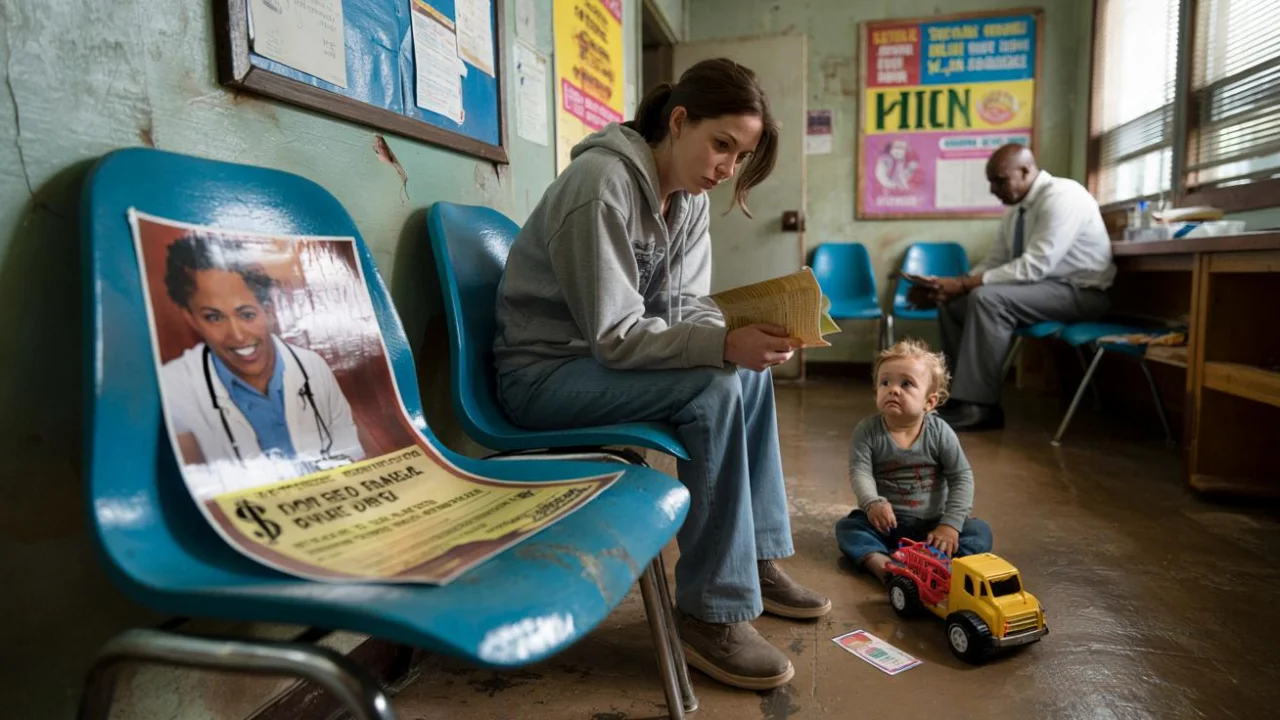
Maria stared at the crisp twenty-dollar bills in her hand, feeling their weight against her calloused palm. The clinic receptionist had smiled warmly when she handed over the “participation fee” for attending the informational meeting. “Just for listening,” she’d said. “No pressure at all.” But as Maria sat in that sterile room, watching a slideshow about “family planning solutions” and “financial incentives,” the pressure felt thick as summer heat.
The presenter spoke in gentle tones about “empowerment” and “choice,” but Maria couldn’t shake the feeling that someone had already decided what choice she should make. When they mentioned the $5,000 payment for permanent sterilization, her mind flashed to her eviction notice, her daughter’s worn-out shoes, the empty cupboards at home.
She wasn’t the only one calculating survival against fertility. Around her sat other women who looked just like her – tired, broke, and desperate enough to trade their reproductive future for a few months of breathing room.
The Modern Face of Paid Sterilization Programs
What happened to Maria isn’t science fiction. Across the United States, paid sterilization programs have quietly emerged, targeting vulnerable communities with cash incentives to undergo permanent birth control procedures. These programs wrap themselves in the language of choice and empowerment, but their targeting reveals a darker truth about who society believes should and shouldn’t have children.
The most notorious example remains Project Prevention, founded in 1997, which has paid over 7,400 people across multiple countries to undergo long-term birth control or sterilization. The organization specifically targets people with drug addictions, offering $300 for long-term contraception and higher amounts for permanent sterilization.
“We’re not trying to control anyone,” says a typical defender of these programs. “We’re just offering options to people who might benefit from them.” But when those “options” are only offered to poor women, women of color, and women struggling with addiction, the selective generosity becomes impossible to ignore.
The demographics tell the real story. Studies of participants in paid sterilization programs reveal overwhelming patterns: 85% are women, 70% are minorities, and nearly all live below the poverty line. This isn’t random distribution – it’s targeted marketing to the most vulnerable.
Breaking Down the Numbers and Impact
To understand how these programs really work, you need to look beyond the feel-good marketing and examine the data:
| Program Aspect | Reality | Impact |
|---|---|---|
| Target Demographics | Poor women, minorities, drug users | Reinforces discriminatory beliefs about “worthy” reproduction |
| Payment Amounts | $300-$5,000 depending on procedure | Creates financial coercion for desperate families |
| Consent Process | Often rushed, limited counseling | High rates of regret and legal challenges |
| Follow-up Support | Minimal to none | Medical complications often ignored |
The programs operate through several key mechanisms:
- Community targeting: Advertisements and outreach focus on low-income neighborhoods, addiction treatment centers, and areas with high minority populations
- Crisis exploitation: Programs approach people during vulnerable moments – while seeking treatment, facing eviction, or dealing with legal troubles
- Information limitation: Participants often receive minimal information about the permanence of sterilization or alternative options
- Quick processing: The time between first contact and procedure is often just days, preventing careful consideration
“What we’re seeing is a systematic targeting of women who lack economic power,” explains Dr. Rebecca Martinez, a reproductive rights researcher. “When someone offers you rent money to make a ‘health decision,’ that’s not really a choice – that’s economic coercion dressed up as medical care.”
The Human Cost of Population Control
Behind every statistic lies a human story of regret, medical complications, and violated rights. Sarah Thompson underwent sterilization through a paid program at age 22, desperate to pay for her sick mother’s medication. Five years later, married and financially stable, she discovered the reversal surgery would cost $15,000 – money she’ll never have.
“They made it sound like I was being responsible,” Sarah remembers. “No one mentioned I’d spend the rest of my life grieving children I’ll never have. No one talked about what happens when your life changes, when you change.”
The medical risks alone should give pause. Sterilization procedures carry surgical risks, potential complications, and psychological impacts that participants rarely fully understand before signing consent forms. When these procedures are promoted primarily for financial rather than health reasons, proper medical counseling often takes a backseat to quick processing.
Legal experts point to disturbing parallels with historical eugenics programs. “We’re seeing the same targeting, the same justifications, just with dollar signs attached,” notes civil rights attorney Michael Chen. “When you systematically encourage certain populations not to reproduce while leaving others alone, you’re implementing population control, not healthcare.”
The broader implications extend beyond individual harm. These programs reinforce dangerous myths about poverty – that poor people have too many children, that reproduction is the source rather than symptom of economic inequality, and that certain lives are less valuable than others.
What Happens Next
Despite mounting criticism, paid sterilization programs continue expanding. New organizations have emerged offering similar services, and some politicians have proposed government-funded versions. The appeal remains the same: a simple, cheap solution to complex social problems.
But real solutions to poverty don’t involve controlling who gets to have children. They involve raising wages, improving healthcare access, investing in education, and addressing the structural inequalities that create desperation in the first place.
“Every dollar spent paying poor women not to have children could instead go toward childcare, job training, or healthcare,” argues policy analyst Jennifer Rodriguez. “We’re literally paying to reduce the next generation instead of investing in supporting families.”
For people like Maria, caught between impossible choices and immediate needs, these programs represent a failure of social support systems. When survival requires trading away fundamental rights, something has gone profoundly wrong with our priorities as a society.
The question isn’t whether people should have reproductive choices – they absolutely should. The question is whether those choices should be shaped by desperation, targeted by demographics, and paid for by organizations that benefit from fewer poor children being born.
Until we address the root causes of poverty rather than trying to prevent poor people from reproducing, these programs will continue exploiting vulnerability and calling it compassion.
FAQs
Are paid sterilization programs legal in the United States?
Yes, though they operate in a legal gray area and face increasing scrutiny from civil rights organizations and medical ethics boards.
How much do these programs typically pay participants?
Payments range from $300 for long-term birth control to several thousand dollars for permanent sterilization procedures.
Who runs these programs?
Most are operated by private nonprofits, though some receive indirect government support through tax exemptions and healthcare partnerships.
Can people reverse sterilization procedures later?
Reversal is possible but expensive ($10,000-$20,000), not always successful, and rarely covered by insurance.
What do medical ethics experts say about these programs?
Many medical organizations have raised concerns about informed consent, coercion, and the targeting of vulnerable populations.
Are there alternatives to address concerns about unplanned pregnancy?
Yes, including improved access to reversible contraception, comprehensive sex education, and addressing poverty through economic support rather than population control.