
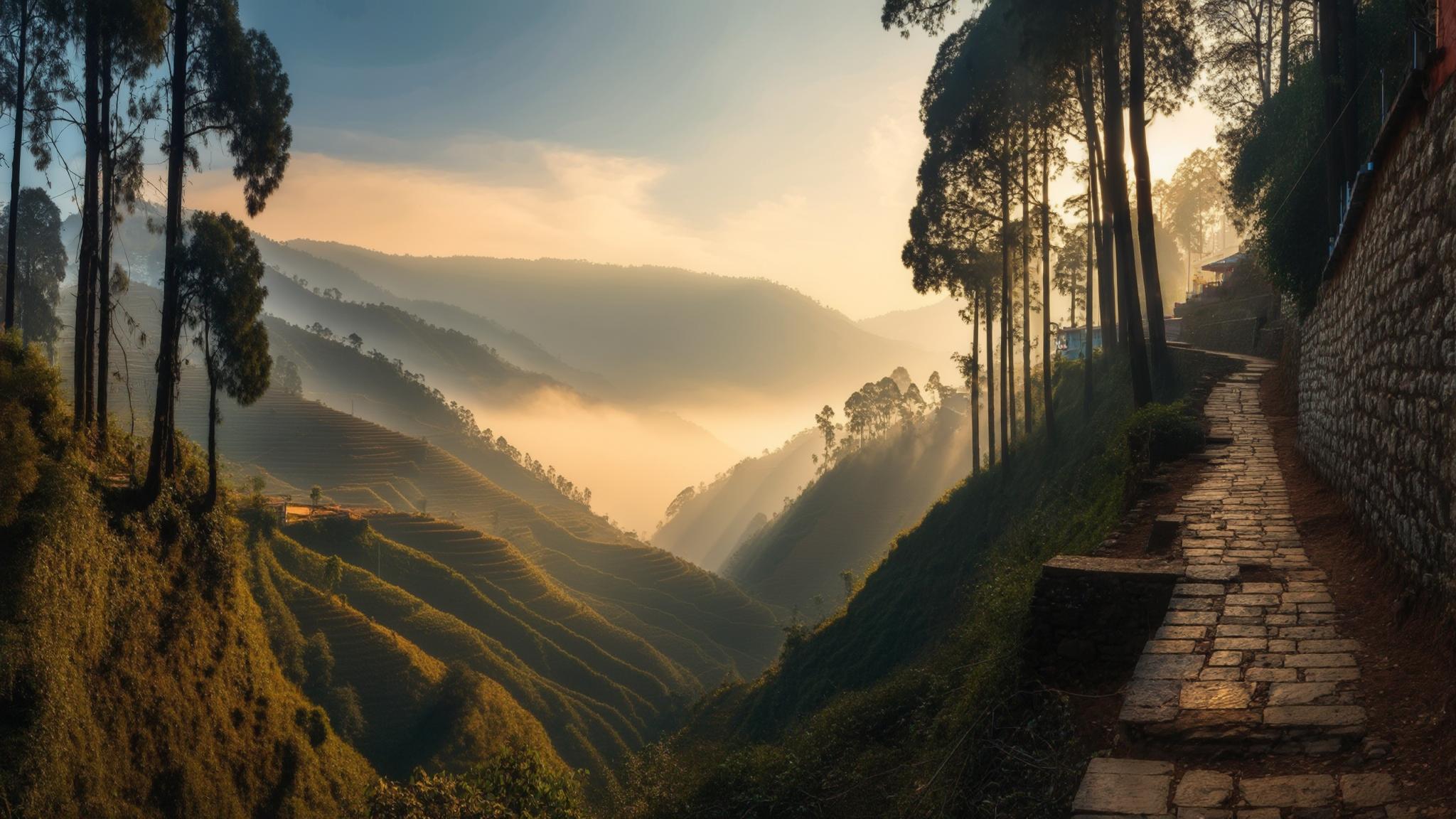
A retired schoolteacher from Dehradun once described her first morning in Landour like this: she had booked a room on a whim after her Mall Road hotel raised its rate mid-stay, climbed 20 minutes uphill through narrow lanes, and woke the next day to an unobstructed view of Bandarpunch and Swargarohini from her window — a sight she had paid twice as much to not see one kilometre below. She returned the following year, and the year after that.
That experience, replicated quietly by a growing number of visitors, captures what makes Landour worth a deliberate detour. The cantonment area — administratively separate from Mussoorie Municipality and still partially governed by the Landour Cantonment Board — sits at approximately 2,100 metres above sea level, about 300 metres higher than the Mall Road promenade. Its streets are narrower, its signboards fewer, and its prices, by most accounts, noticeably lower.
What Landour Actually Is — and Why Most Visitors Skip It
Landour is not a village or a separate hill station. It is a cantonment settlement that was established by the British East India Company in 1827 as a convalescence depot for troops. Its boundaries overlap geographically with upper Mussoorie, but it functions under a distinct administrative body, the Landour Cantonment Board, which according to the Board’s publicly listed records oversees road maintenance, heritage building regulation, and public sanitation for the area.
The area is perhaps best known internationally as the longtime home of author Ruskin Bond, who has lived in Landour for decades. Bond’s presence has made Landour a modest literary pilgrimage destination, with the Char Dukan tea stalls — four small shops clustered at a bend in the road near Chukkar — regularly mentioned as a gathering point for readers who hope, occasionally successfully, to spot him at breakfast.
Most day-trippers to Mussoorie never reach Landour for a straightforward reason: there is no cable car, no amusement park, and no prominent signage directing visitors uphill. The approach from Mall Road requires either a 20-to-30-minute uphill walk through Kulri Bazaar and Sisters Bazaar, or a shared auto-rickshaw ride that costs approximately ₹30–₹50 per person.
The Landour Loop: A 5-Kilometre Walk Worth Planning Your Day Around
The defining activity in Landour is the Chukkar — a roughly 5-kilometre circular walking path that wraps around the upper ridge of the hill. On a clear morning, the Chukkar offers sightlines to a long arc of the central and Garhwal Himalaya, including Swargarohini (6,252 m), Bandarpunch (6,316 m), and on exceptionally clear winter days, the distant profile of Kedarnath range.
The walk itself is largely flat once the initial climb from Kulri Bazaar is completed. The path passes through stands of oak and rhododendron, and the rhododendrons bloom red and pink between late February and early April, making that window one of the most visually rewarding times to visit. The Chukkar takes approximately 90 minutes to complete at a moderate walking pace.
Photographers and birders tend to favour the stretch between Kellogg Church — a 19th-century stone structure still in active use — and the viewpoint near the old British-era cemetery at St. Paul’s Church. Both structures are listed in the Landour Cantonment Board’s heritage documentation and are accessible on foot without a fee.
Where to Eat and What It Costs in Landour
Char Dukan, the cluster of four tea stalls near the top of the Chukkar loop, is the most cited eating stop in Landour. The stalls serve simple north Indian and Garhwali breakfasts — aloo parathas, maggi noodles, omelettes, and several varieties of tea — at prices that a visitor in March 2026 reported averaging ₹80–₹150 per person for a full breakfast. The stalls open around 7:30 a.m. and are busiest between 9 a.m. and 11 a.m.
Beyond Char Dukan, Landour Bazaar — the narrow commercial lane lower on the hill — has bakeries, provision stores, and small dhabas where a full meal rarely exceeds ₹200 per person. Cambridge Book Depot, one of the older bookshops in the Mussoorie-Landour area, operates on this stretch and stocks a reasonably broad selection of Indian fiction and regional history titles.
Staying in Landour: Accommodation Options by Budget
Landour has a smaller accommodation inventory than Mussoorie’s Mall Road corridor, but the range runs from budget guesthouses to heritage homestays. Rates shift considerably between seasons: weekdays in March or November are the lowest-demand periods, while the May–June peak and the October long-weekend cluster drive prices to their highest points.
Booking directly with guesthouses — rather than through third-party platforms — frequently results in lower rates, according to multiple property owners contacted for this report. Several properties in Landour do not list on major booking aggregators at all, making a phone call or email inquiry the only method of reservation.
Best Season to Visit and What to Avoid
Landour’s elevation gives it a distinct seasonal pattern from the valley below. Summers (April to June) are the most crowded period, but temperatures at 2,100 metres rarely cross 25°C, making the heat tolerable compared to Dehradun or Delhi. The monsoon (July–September) brings heavy rainfall and frequent cloud cover that can obscure mountain views for days at a stretch; the Chukkar path becomes slippery and some sections are prone to minor landslips.
Late September through November represents the clearest visibility window for Himalayan views. The post-monsoon atmosphere is clean, the rhododendrons are dormant but the oak forests are rust and gold, and accommodation prices drop significantly after the October long weekends. Winter (December–February) brings cold nights that can drop below 0°C, occasional snowfall, and a very quiet atmosphere — suited to travellers who prioritise solitude over comfort.
- Best for mountain views: October–November, late February–March
- Best for rhododendron bloom: Late February to early April
- Best for budget travel: Weekdays in March, November, or January
- Avoid if possible: May–June weekends, Diwali and Christmas long weekends (prices surge 2x–3x)
According to the Uttarakhand Tourism Development Board, Mussoorie and its surrounding areas — which include Landour — receive the highest visitor volumes in May and June annually, with the state recording millions of tourist arrivals in Uttarakhand’s hill stations during that two-month window. Landour, by virtue of its uphill position and absence of ticketed attractions, absorbs a smaller fraction of that flow.