
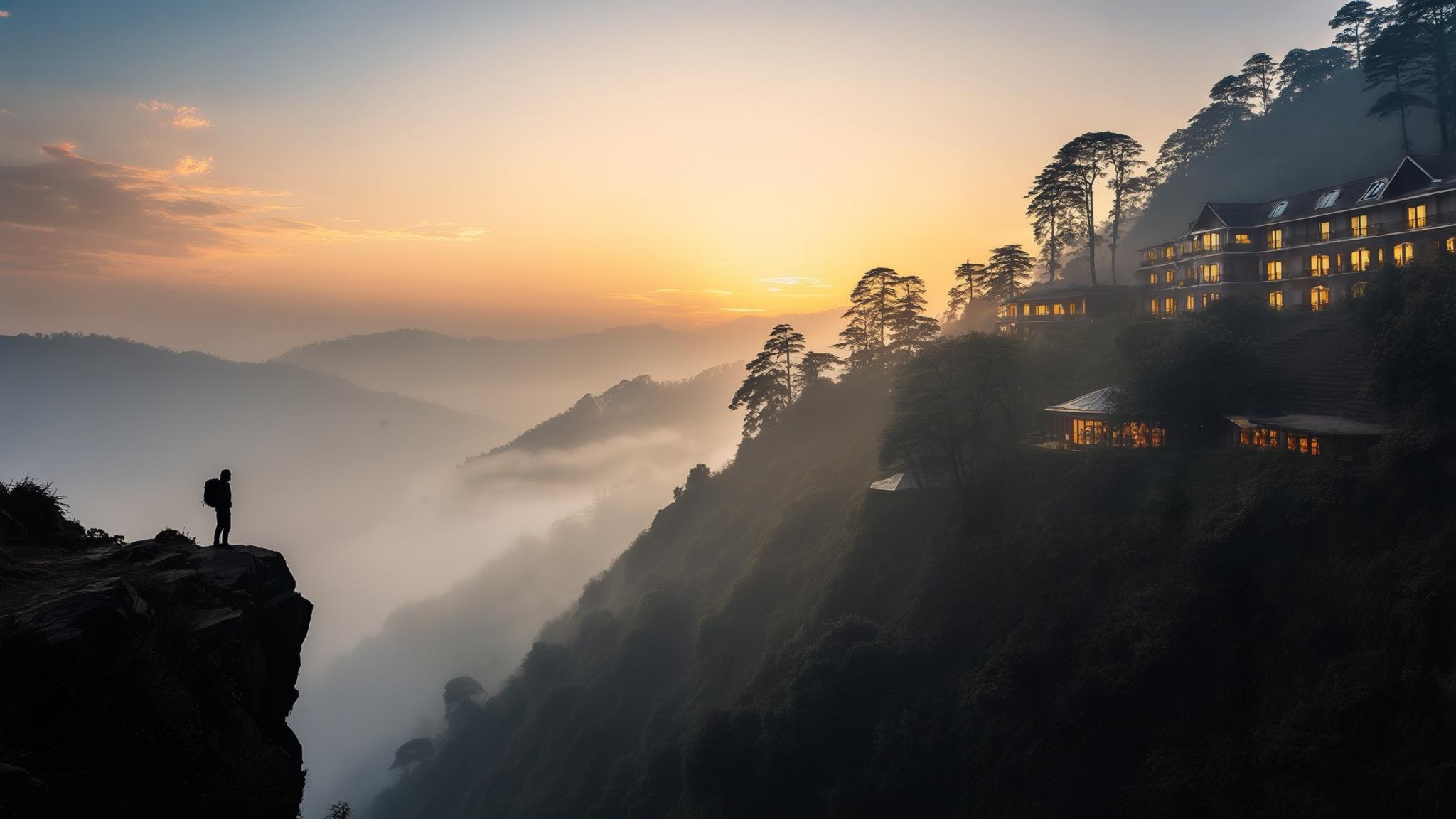
Contrary to what every travel blog written in 2019 will tell you, Mussoorie’s biggest problem in 2026 is not a lack of things to do — it is that most visitors spend their entire trip doing the wrong things, in the wrong season, with an outdated budget estimate in their heads. The Queen of Hill Stations has been quietly but significantly overhauled, and arriving unprepared costs you both money and experience.
New tourist regulations are now actively in force. A fresh crop of luxury properties has opened along the Kempty Fall Road corridor. And the crowds that once peaked in June now arrive in April — which, if you are reading this in early April 2026, means you are already inside the surge window. None of this is widely covered in the standard listicle format. This article is written for people who want to get it right.
The 2026 Budget Reality: What ₹6,000 Actually Gets You
The ₹6,000 per person figure circulating across travel forums is real, but it is the absolute floor — not a comfortable baseline. That number assumes shared accommodation in a budget guesthouse in the Landour or Library Bazaar area, meals at dhabas and local eateries, and zero splurging on cable car rides or paid viewpoints. According to Moneycontrol’s Mussoorie travel coverage, there are now specific tourist rules in place that can add small but real costs — including designated parking zones and entry fees at certain managed viewpoints.
For a couple traveling from Delhi, here is how the numbers actually break down across three days and two nights at a mid-range level:
The gap between budget and mid-range is largely driven by accommodation. Mussoorie has seen a notable increase in premium inventory — the JW Marriott Mussoorie Walnut Grove Resort & Spa on Kempty Fall Road is priced at approximately ₹28,000–₹30,000 per night, which puts it firmly in the luxury bracket. For most domestic travelers, the sweet spot sits between ₹3,500 and ₹6,000 per night for a clean, well-located property with valley views.
The New Tourist Rules That Can Derail Your Trip
Mussoorie’s local administration has implemented a set of rules that are strictly enforced during the peak season — and April through June is firmly peak season. The most impactful change affects private vehicles: private cars are restricted from entering certain stretches of Mall Road during designated hours, typically 10 AM to 10 PM on weekends and public holidays. Visitors who drive up from Delhi are often caught off guard when they cannot park anywhere near the main strip.
Designated parking is available at multiple points below Mall Road — including the Library Bazaar lot and the Picture Palace area — but expect to walk 10–20 minutes uphill, or hire a local shared vehicle for the final stretch. As Moneycontrol’s tourist rules guide highlights, travelers who are unaware of these restrictions end up stuck in traffic for hours before being turned back.
Beyond traffic rules, visitors should be aware of the litter fine system now in place across key tourist zones, including Kempty Falls and Gun Hill. Fines can range from ₹500 to ₹2,000 for littering in protected areas. The local municipal board has also increased the entry fee at Kempty Falls to ₹50 per person as of the 2025 revision.
- Mall Road vehicle ban: Weekends and holidays, 10 AM–10 PM, for private cars
- Kempty Falls entry fee: ₹50 per person (revised 2025)
- Littering fines: ₹500–₹2,000 in designated protected zones
- Cable Car (Gun Hill): ₹150 per person one-way; timings subject to weather
- Drone flying: Requires prior permission from local authorities — do not assume it is allowed
Where Mussoorie Sits in India’s 2026 Hill Station Landscape
India’s summer travel market in 2026 is more competitive than it has been in a decade. Shimla, Ooty, Coorg, and Kasauli are all aggressively marketing themselves to the same domestic audience that Mussoorie targets. According to NDTV’s 2026 hill station rankings, Mussoorie remains among the top choices for north Indian families, largely because of its accessibility from Delhi — approximately 290 km or 6–7 hours by road — and its established infrastructure.
What separates Mussoorie from its competitors right now is the pace of luxury hotel development. The JW Marriott Walnut Grove, already one of the most booked properties in the Uttarakhand hills, has been joined by newer entrants along the Kempty Fall Road corridor. Meanwhile, Le Méridien Dehradun Resort & Spa has debuted in the foothills below, offering guests a base that is less crowded than Mussoorie itself but within 45 minutes of Mall Road.
This bifurcation — budget backpacker at one end, luxury resort guest at the other — is reshaping how Mussoorie works. The mid-range hotel category (₹3,000–₹6,000 per night) is actually the most squeezed, with older properties that have not renovated since the early 2010s now competing against newer boutique guesthouses in Landour and Cloud’s End that charge similar rates but offer a far superior experience.
How Many Days Do You Actually Need — and When Should You Avoid Mussoorie
Two nights and three days is the honest answer for a first-time visitor who wants to cover the main circuit without feeling rushed. That gets you Mall Road in the evening, Gun Hill by cable car in the morning, a day trip to Kempty Falls, and a quiet walk through Landour — the older, quieter cantonment area above Mall Road that most tourists skip entirely. Landour is home to the famous Char Dukan tea stalls and has a character that Mall Road lost decades ago.
For repeat visitors or those interested in trekking, hiking to Benog Wildlife Sanctuary or George Everest’s House adds a full additional day. The George Everest trek — roughly 6 km round trip from Park Estate — offers some of the most dramatic Himalayan views accessible without specialist gear, and sees a fraction of the footfall of Gun Hill.
On the question of when to avoid Mussoorie: the window from late June through mid-August is the monsoon season, and while the scenery turns dramatically green, the risk of landslides on the Dehradun–Mussoorie highway is real and non-trivial. Roads can be closed for hours or days. If you are traveling with elderly family members or young children, this window carries genuine logistical risk that the Instagram photos do not communicate.
The second period to approach with caution is the Christmas–New Year window. While it is undeniably magical if there is snowfall, hotel prices can triple, Mall Road becomes genuinely shoulder-to-shoulder crowded, and the experience of the town itself — its quiet lanes, its views, its pace — disappears under the weight of peak tourist volume. January, post the rush, is when Mussoorie returns to something closer to its real self.
What Comes Next for Mussoorie as a Destination
The hill station is at an inflection point. On one hand, the infrastructure investment in premium hospitality is real and growing — new properties, better road connectivity from Dehradun’s expanding rail and air links, and increasing interest from the international tourism segment that is discovering Uttarakhand. On the other hand, overtourism pressures are visible: water scarcity during peak season, waste management strain at Kempty Falls, and an increasing sense among regular visitors that the quieter Mussoorie they remembered is harder to find.
The Uttarakhand government’s push to develop Dhanaulti — 25 km from Mussoorie — as an overflow destination is worth watching. Dhanaulti is quieter, higher in altitude at approximately 2,250 metres, and sees a fraction of Mussoorie’s tourist load. Several boutique properties have opened there in the last two years, and it functions well as either a stand-alone destination or a day trip from Mussoorie.
For travelers planning a visit in the next six months — April through October 2026 — the advice is straightforward: book accommodation at least three weeks in advance for weekends, arrive midweek if flexibility exists, and build Landour and the George Everest trail into your itinerary rather than spending a third day on Mall Road. The version of Mussoorie worth experiencing is still very much there. It just requires a little more intentionality to find it.
(function(){var w=document.getElementById(‘pvv-scenario-s1775652208999dy3o’);if(!w)return;var btns=w.querySelectorAll(‘button[data-choice]’);btns.forEach(function(b){b.addEventListener(‘click’,function(){if(w.dataset.revealed)return;w.dataset.revealed=’1′;btns.forEach(function(x){x.style.opacity=x===b?’1′:’0.45′;x.style.cursor=’default’;x.style.transform=’none’});var o=document.getElementById(‘s1775652208999dy3o-out-‘+b.dataset.choice);if(o){o.style.display=’block’}});b.addEventListener(‘mouseenter’,function(){if(!w.dataset.revealed){b.style.borderColor=’#38bdf8′;b.style.transform=’translateX(4px)’}});b.addEventListener(‘mouseleave’,function(){if(!w.dataset.revealed){b.style.borderColor=’#334155′;b.style.transform=’none’}})})})();
.pvv-faq-section details summary::-webkit-details-marker{display:none}.pvv-faq-section details summary::marker{display:none;content:””}.pvv-faq-section details[open] summary .pvv-faq-arrow{transform:rotate(90deg)}