
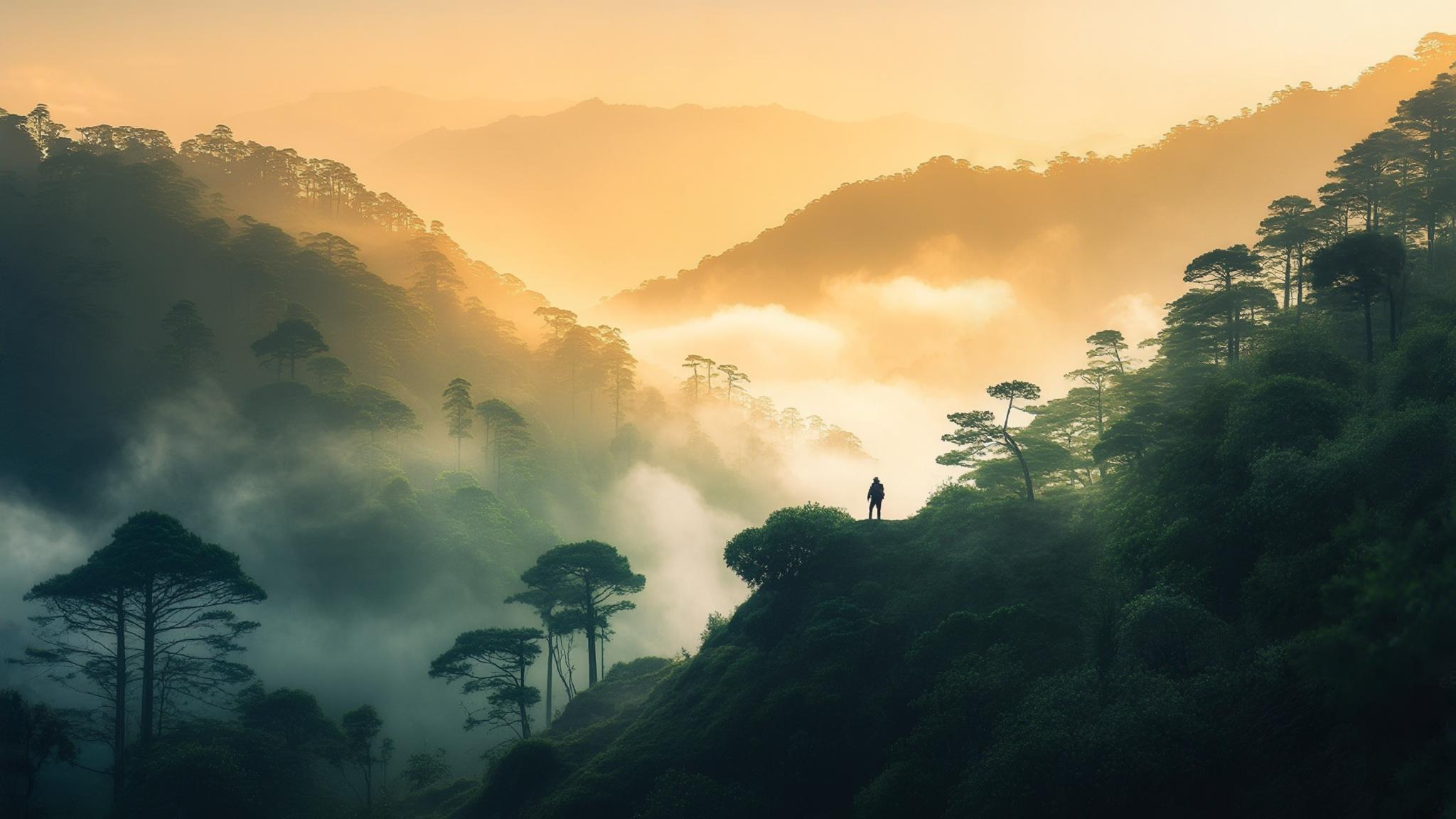
Have you ever stood on Gun Hill at 7 AM, watching the Himalayas disappear behind a wall of tourist minibuses and exhaust fumes, wondering whether this was really worth the eight-hour drive from Delhi? If that image feels familiar, there is a good chance you visited Mussoorie at exactly the wrong time — and you are far from alone.
Mussoorie draws approximately 30 lakh visitors annually, and a disproportionate share of them arrive in May and June. School vacations, rising plains temperatures, and decades of word-of-mouth have cemented summer as the default window for a Mussoorie trip. The assumption is so widespread that most travel agents will not even question it when you call to book.
But the assumption is wrong — and the evidence is sitting in plain sight for anyone willing to look past the brochures.
The Common Belief: Summer Is Mussoorie’s Golden Window
The logic behind a May–June Mussoorie trip feels airtight on the surface. Delhi and NCR are sweltering at 42–45°C, schools are on break, and Mussoorie sits at a comfortable 2,000 metres above sea level where temperatures hover around 20–25°C. It is the obvious escape hatch.
Travel content from the 1990s and early 2000s reinforced this idea, and that framing has never really been updated. Most popular listicles still label April–June as the “best time to visit Mussoorie” without questioning what “best” actually means for the experience on the ground.
Hotels lean into this cycle too. Properties on The Mall Road and Camel’s Back Road charge peak-season rates from late April onward, and many budget guesthouses near Library Chowk are fully booked weeks in advance. The assumption of summer as prime season has become a self-fulfilling prophecy that benefits accommodation owners but rarely the traveler.
The Crack in the Story: What Summer in Mussoorie Actually Looks Like
Step off a Volvo bus at Picture Palace bus stand on any Saturday in late May and the reality hits immediately. The Mall Road — a 5-kilometre stretch that is theoretically a pedestrian promenade — is gridlocked with vehicles that should not be there. The air carries diesel and deep-fried corn, not the pine-and-cedar scent Mussoorie is actually famous for.
Kempty Falls, the most-visited natural attraction near Mussoorie, sees queues of several hundred people during summer weekends. The pool at the base of the falls, which is genuinely beautiful in lower-traffic months, becomes a crowded concrete-edged tub. Local taxi drivers — some of the most candid sources of information you will find anywhere — openly tell visitors that they stop enjoying their own town between May and mid-July.
The translation: “We locals don’t go out ourselves in May. So much traffic. The real Mussoorie is in October.” It is not a unique opinion — it is the default view among people who live there year-round.
Why the Timing Is Actually Wrong: Evidence Beyond Anecdote
The problems with summer Mussoorie go beyond crowds. They are structural, climatic, and financial — and they compound each other in ways most tourists do not anticipate until they are already there.
Visibility is poor in summer. The pre-monsoon haze that builds over the Gangetic plains from April onward pushes into the foothills. Himalayan views from Lal Tibba — the highest point in Mussoorie at 2,275 metres — are often obscured by atmospheric haze from late April through June. The snow-covered Bandarpunch and Srikanta peaks that make Lal Tibba famous are frequently invisible during this period.
Road conditions deteriorate fast. The National Highway 707A connecting Dehradun to Mussoorie carries more than 10,000 vehicles on summer weekends according to local traffic estimates, against a designed capacity of roughly 3,500. Landslides and road damage from early monsoon rains — which begin in Mussoorie as early as mid-June — add unpredictability to journey times.
The financial cost is significant. A comparable 2-night stay that costs roughly ₹5,500–₹7,000 total in October (including meals and one or two activities) can easily reach ₹18,000–₹22,000 in peak May, for an experience that is objectively worse on almost every metric.
The Real Truth: When Mussoorie Actually Rewards You
Mussoorie has two largely undiscovered sweet spots: late September through early November, and mid-February through March. Both windows offer cleaner air, negotiable hotel rates, thinner crowds, and — crucially — the mountain views that drew travelers to Mussoorie in the first place.
October is arguably the finest month. Post-monsoon clarity means Himalayan views from Lal Tibba and Cloud’s End are exceptional — on clear mornings you can see ranges more than 200 kilometres away. Temperatures sit between 10°C and 22°C, making walking The Mall Road or hiking the Camel’s Back Road genuinely pleasant rather than sweaty and crowded. Accommodation rates are at their lowest before the brief winter-holiday bump.
February and March offer something summer cannot. The rhododendron forests along the Benog Wildlife Sanctuary trail — a 5-kilometre walk from Clouds End — bloom between late February and mid-March, painting the hillsides in deep crimson and pink. Snow lingers on the higher ridges, making Lal Tibba’s panorama look freshly washed. Hotel rates remain low and you can walk The Mall Road at 6 PM without feeling like you are in a crowded metro station.
The Benog Wildlife Sanctuary itself, located about 11 kilometres from Library Chowk via a shared jeep or taxi (approximately ₹400–₹600 return), sees almost no visitors in these shoulder months. Leopard sightings, while never guaranteed, are reported more frequently when human traffic is low, according to the Uttarakhand Forest Department’s visitor logs for the sanctuary.
What This Actually Means for Your Next Trip
Rethinking when you visit Mussoorie does not require dramatic sacrifice — it mostly requires unlearning a piece of received wisdom that was never particularly accurate to begin with. The school-holiday calendar drove summer Mussoorie tourism; that does not mean summer is climatically or experientially optimal.
For couples, October and March are the two months where Mussoorie most resembles the romantic hill station it is marketed as. The Mall Road at dusk with clear Himalayan silhouettes in the distance, a near-empty Camel’s Back Road in the morning, and a table at any restaurant without a 45-minute wait — these are the experiences that summer photographs promise but rarely deliver.
For families with school-age children, the Dussehra–Diwali window (typically mid-to-late October) offers a practical compromise: schools are on a short break, crowd levels are still well below summer peaks, and the weather is genuinely pleasant for children. Prices climb slightly during Diwali week itself, but remain well below May rates.
The traveler who goes to Mussoorie in October, stays in a well-located guesthouse near Landour Bazaar for ₹2,200 a night, eats maggi and chai at a dhaba on the Char Dukan hilltop, and watches the Himalayan arc at sunrise from Lal Tibba — that traveler is having the Mussoorie experience. The one inching forward in a May traffic jam on Camel’s Back Road is paying three times as much for a fraction of it.
Mussoorie is not broken. The timing strategy used by most tourists is. The hill station that locals rave about, the one in the photographs that made you want to go in the first place — it exists. It is just not available in May at ₹7,000 a night. It is available in October at ₹2,000, and it is waiting.