
Every summer, roughly 3 to 4 million tourists descend on Mussoorie between April and June, clogging the 35-kilometre stretch from Dehradun in bumper-to-bumper traffic that can stretch your journey to four hours. Hotels triple their rates. The famous Mall Road becomes a slow-moving human river. And the Himalayan views that supposedly draw everyone here? Often blocked by summer haze.
The conventional wisdom — that May and June are the best months to visit Mussoorie — is one of Indian travel’s most persistent myths. Local hoteliers, seasoned guides, and Mussoorie residents will tell you something entirely different. The months that genuinely deliver the experience people come here for are October, November, and the short window of late February through mid-March.
The Summer Myth and How It Took Root
The idea that Mussoorie is a summer destination traces back to the British colonial era, when it served as a hill station retreat from the scorching plains. For people escaping 45°C Delhi summers, even a hazy, crowded Mussoorie at 2,005 metres felt like paradise. That logic made sense in 1890. It no longer holds.
Modern Indian families still follow the same seasonal calendar — school holidays in May and June, combined with the instinct that “hill station equals summer.” The result is a self-reinforcing crowd problem. More people go in May because everyone goes in May. The experience suffers, but the habit persists because few travelers have a reference point for what Mussoorie looks like in October.
What summer actually delivers: temperatures of 15–25°C (pleasant enough, but hardly cool), atmospheric haze from the Indo-Gangetic Plain that obscures Himalayan peaks, and accommodation pressure that pushes even mid-range hotels above ₹5,000 per night on weekends.
What Actually Happens to Mussoorie in October and November
October is when Mussoorie quietly transforms. The monsoon — which runs from late June through mid-September and brings landslide risks along with spectacular greenery — clears out completely by late September. What follows is arguably the most photogenic period the hill station offers.
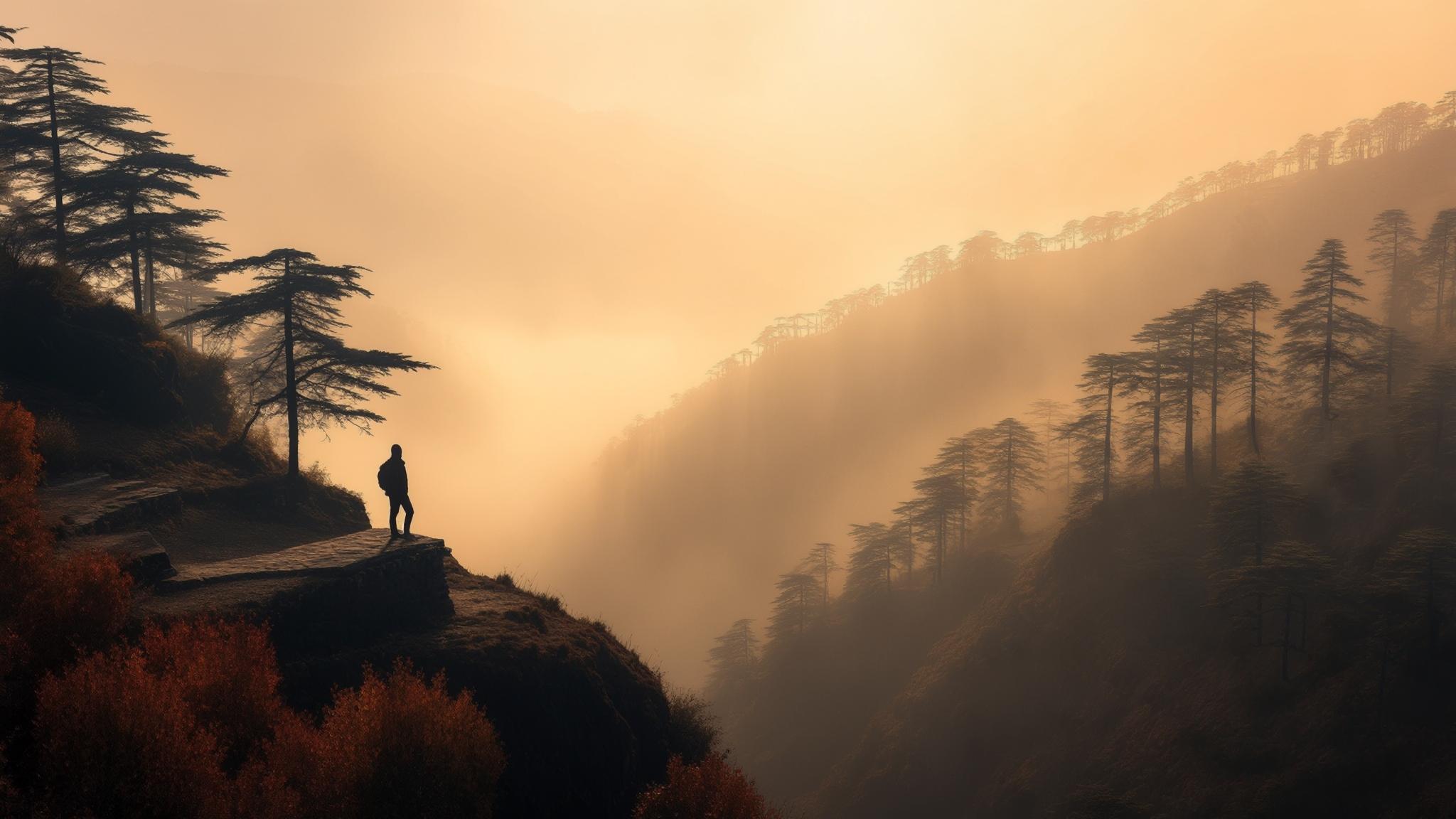
Post-monsoon skies are crystalline. On a clear October morning, you can see Bandarpunch (6,316 metres), Swargarohini, and the Gangotri range from Gun Hill or the Camel’s Back Road without any haze obstruction. This is the view that Mussoorie’s Instagram presence is built on — and it almost never happens in May or June.
Temperatures in October sit between 8°C and 18°C — genuinely cool, requiring a light jacket, matching what most people imagine when they think “hill station.” Hotel occupancy drops sharply after the Dussehra-Diwali window (which itself sees a brief spike), and by the first week of November, you can book quality properties on Camel’s Back Road or near Library Chowk for under ₹3,000 a night.
The walks that define Mussoorie — the 3-kilometre Camel’s Back Road loop, the climb to Gun Hill via ropeway or trail, the quieter paths toward Lal Tibba — are genuinely enjoyable in October. In May, they are obstacle courses.
The February-March Window That Almost Nobody Books
The late-winter window from mid-February to mid-March is Mussoorie’s least-discussed secret. Snow, when it falls, typically arrives between December and February — and the aftermath is worth traveling for. The oak and rhododendron forests above Landour hold snow on their branches for days after a fresh fall. Lal Tibba, the highest point accessible by road at approximately 2,275 metres, offers snow-dusted views of Kedarnath and Chaukhamba on clear days.
By late February, rhododendrons begin blooming across the hillsides above Landour Bazaar — reds and pinks against a backdrop of snow-capped peaks. This is one of the most visually striking things Mussoorie offers, and it happens before a single May tourist arrives. Temperatures range from 2°C at night to around 14°C in the afternoon, so packing is straightforward: a good thermal layer and a windproof jacket.
Hotel rates in February are at their annual low. Many properties offer rates 40–50% below their summer pricing. The tradeoff is that some smaller restaurants and shops operate on reduced hours, but the core experience — the views, the walks, the food at Landour’s famous Char Dukan — is fully available.
A Practical Season-by-Season Comparison
What This Means for Your Next Mussoorie Trip
The practical implication is straightforward: if you have flexibility in your schedule, avoid May and June entirely unless your only goal is escaping Delhi heat and the Mussoorie experience itself is secondary. For couples seeking atmosphere and mountain views, October is the single best month. For families wanting snow without the deep-winter cold, late February hits a usable middle ground.
The budget difference alone justifies the rethink. A couple spending two nights in Mussoorie in October can realistically manage the trip — travel, accommodation, food, and activities — for approximately ₹8,000–₹12,000 total. The same trip in May, with peak hotel rates and the associated costs, runs ₹18,000–₹25,000 for a comparable experience that is, by most objective measures, worse.
Mussoorie is a genuinely beautiful place. The rhododendron forests, the Himalayan panoramas from Lal Tibba, the colonial-era bungalows of Landour, the chai at Char Dukan — none of this requires summer crowds and inflated prices. The Queen of Hills has been waiting for you in October all along. Most people just never thought to show up.