
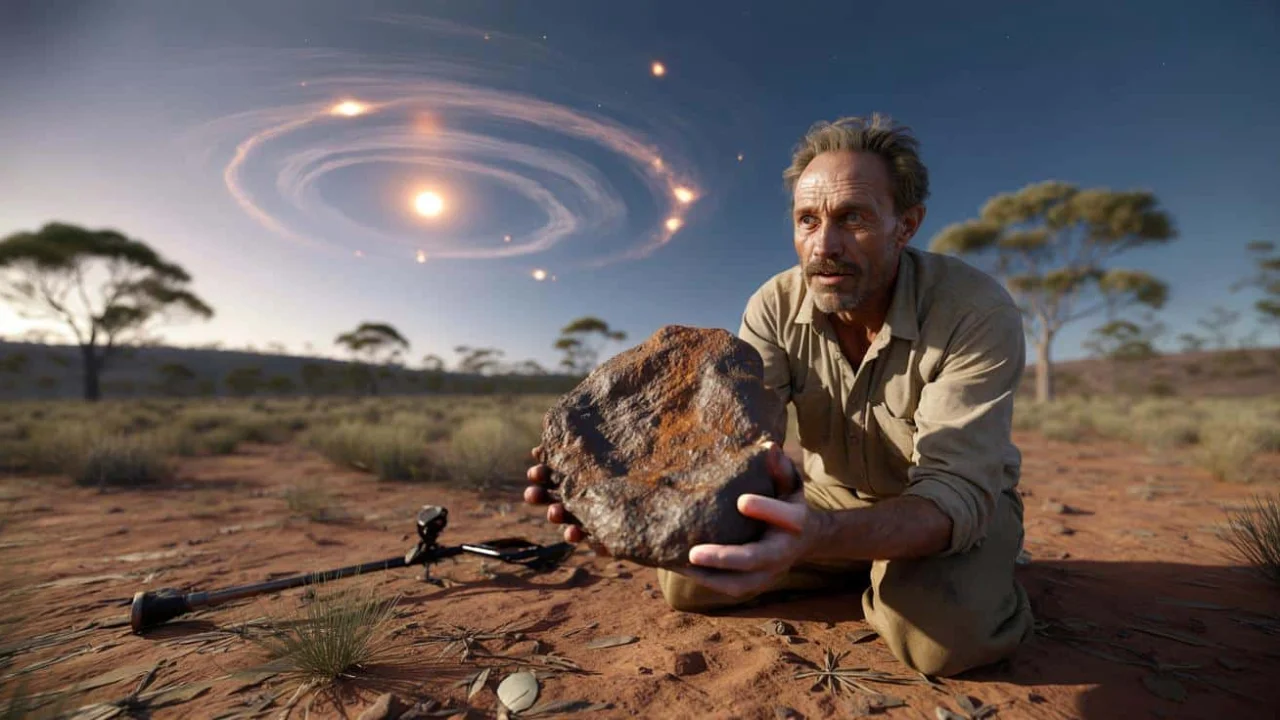
Picture this: you’re out with your metal detector on a weekend, dreaming of finding something valuable buried in the dirt. The machine starts beeping wildly, and you dig up what looks like an old, rusty rock. Your heart races – could this be your lucky day?
That’s exactly what happened to David Hole in 2015. But what he thought might make him rich turned out to be worth far more than gold – scientifically speaking. His stubborn rock that refused to crack open was actually a 4.6-billion-year-old piece of our solar system’s history.
This meteorite discovery would eventually rewrite what we know about space rocks falling to Earth, proving that sometimes the most valuable treasures aren’t the ones we expect to find.
When Dreams of Gold Meet Reality
David Hole was metal detecting in Maryborough Regional Park, northwest of Melbourne, when his equipment went crazy over a dense, reddish rock. The area sits in Victoria’s historic goldfields, where prospectors have struck it rich for generations.
The rock had all the right signs – it was incredibly heavy for its size, oddly shaped, and covered in strange pits. In gold country, these features usually mean one thing: there’s precious metal hiding inside.
But back in his workshop, Hole’s excitement turned to frustration. He tried everything to crack open what he was sure contained a gold nugget. Saw blades dulled against it. Grinders couldn’t bite into it. He soaked it in acid, drilled holes, and even took a sledgehammer to it.
“This was no ordinary rock,” says Dr. Dermot Henry, a geologist at Melbourne Museum. “Most rocks would have cracked or shown some damage from that kind of treatment. This thing was virtually indestructible.”
For years, the mysterious rock sat in Hole’s shed like an unsolved puzzle. Finally, curiosity got the better of him, and he decided to take it to experts at Melbourne Museum.
The Moment Everything Changed
Museum geologists see fake “meteorites” constantly. People bring in everything from industrial slag to chunks of old farm equipment, convinced they’ve found space rocks. Most specimens get identified and politely returned within minutes.
But when Dr. Henry and his colleague Bill Birch examined Hole’s rock, they knew immediately this was different. The unusual sculpted surface, incredible density, and resistance to damage all pointed to one conclusion – this was the real deal.
Here’s what made this meteorite discovery so special:
- The rock weighed 17 kilograms (37.5 pounds) but was surprisingly compact
- Its surface showed distinctive “thumbprint” patterns from burning through Earth’s atmosphere
- Chemical analysis revealed it was 4.6 billion years old
- It contained rare minerals only found in space
- The internal structure showed it came from an asteroid belt
“When we cut into it with a diamond saw, we could see the beautiful crystalline structure inside,” explains Dr. Henry. “It was like looking at a time capsule from the very beginning of our solar system.”
| Property | Maryborough Meteorite | Typical Earth Rock |
|---|---|---|
| Age | 4.6 billion years | Up to 4 billion years |
| Weight | 17 kg | Varies widely |
| Composition | Iron-nickel with rare minerals | Silicates, carbonates |
| Origin | Asteroid belt | Earth’s crust/mantle |
| Rarity | Extremely rare | Common |
What This Means for Science and Space Research
The Maryborough meteorite, as it’s now officially known, represents only the 17th meteorite ever confirmed in Victoria. That makes it incredibly rare – rarer than gold, ironically enough.
But its value goes far beyond rarity. This space rock is helping scientists understand how our solar system formed billions of years ago. When they analyzed its composition, researchers found it contains materials that predate Earth itself.
“These meteorites are like cosmic messengers,” says Dr. Sarah Noble, a planetary scientist. “They carry information about conditions in space that we simply can’t get any other way.”
The discovery is already influencing several areas of research:
- Understanding asteroid composition and behavior
- Learning about the early solar system’s formation
- Improving meteorite identification techniques
- Studying how space rocks survive atmospheric entry
- Developing better methods for detecting incoming meteors
For the average person, this meteorite discovery highlights something fascinating – pieces of our cosmic neighborhood are literally falling from the sky all the time. Most burn up completely, but occasionally, one survives the fiery journey through our atmosphere.
How to Spot a Real Meteorite
David Hole’s experience teaches us that real meteorites don’t behave like regular rocks. If you ever find something unusual while metal detecting or just walking around, here are the key signs to look for:
Real meteorites are typically much heavier than Earth rocks of similar size. They often have a dark, sometimes rusty exterior called a fusion crust, formed when the outer layer melts during atmospheric entry. The surface usually shows distinctive flow patterns or “thumbprints.”
“The number one rule is that if you can easily break it with a hammer, it’s probably not a meteorite,” advises Dr. Birch. “Real space rocks are incredibly tough because they’ve survived millions of years in space and a violent trip through our atmosphere.”
Most importantly, real meteorites contain iron and will attract a magnet. However, not everything magnetic is a meteorite – plenty of Earth rocks and industrial materials also contain iron.
The Maryborough meteorite discovery proves that sometimes the most extraordinary finds come when we least expect them. David Hole went looking for gold but ended up with something far more valuable to science – a genuine piece of our solar system’s ancient past.
This remarkable story reminds us that our planet is constantly being visited by travelers from deep space, carrying secrets about the cosmos that we’re only beginning to understand.
FAQs
How can you tell if a rock is really a meteorite?
Real meteorites are unusually heavy, have a dark fusion crust, attract magnets, and are extremely difficult to break or damage with ordinary tools.
Are meteorites valuable?
While they’re scientifically priceless, meteorites can be worth hundreds to thousands of dollars depending on their rarity, size, and composition.
How often do meteorites fall to Earth?
Scientists estimate that about 500 meteorites reach Earth’s surface each year, but most fall in oceans or remote areas where they’re never found.
What’s the difference between a meteor and a meteorite?
A meteor is the bright streak you see in the sky when space debris burns up in our atmosphere. A meteorite is the piece that actually survives and hits the ground.
Where should I take a suspected meteorite for identification?
Contact your local natural history museum, university geology department, or planetarium. They have experts who can properly identify space rocks.
Can meteorites be dangerous?
While extremely rare, meteorites can cause damage if they’re large enough. However, most that reach Earth are small and pose no threat to people or property.