
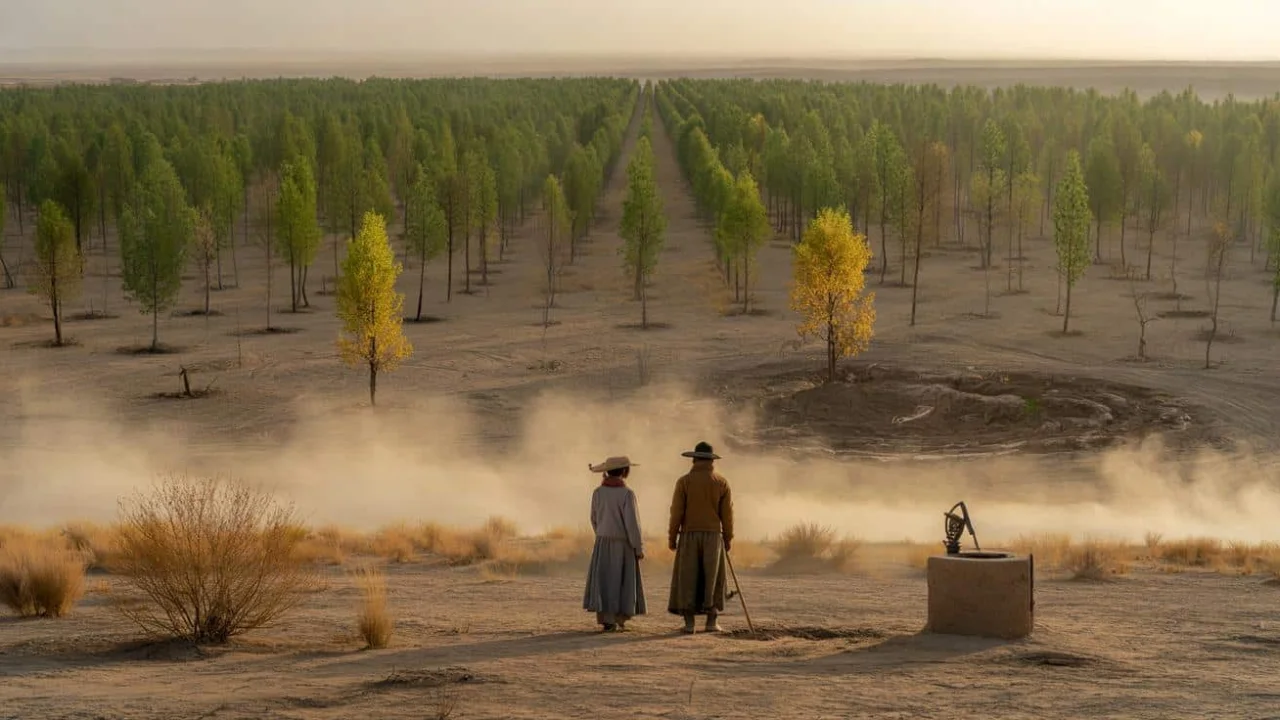
Li Wei remembers the day his grandmother’s well went dry. She’d been drawing water from the same spot for forty years, watching her vegetable garden thrive in the harsh landscape of Inner Mongolia. But after the tree-planting crews came through in 2003, the water table dropped so fast that her ancient pump could only suck air.
“The officials said the trees would save us from the desert,” Li recalls, staring at rows of struggling poplars that now dot what used to be natural grassland. “But they never asked what we were being saved from.”
Li’s story echoes across northern China, where one of the world’s most ambitious environmental projects has sparked an unexpected debate among scientists and local communities.
China’s Great Green Wall: A Forest Born from Fear
The Great Green Wall of China stretches across 4,480 kilometers of the country’s northern border, making it three times longer than its famous stone predecessor. Since 1978, Chinese authorities have planted over a billion trees across 13 provinces, spending roughly $8 billion on what they call the “Three-North Shelter Forest Program.”
The motivation was clear and urgent. Desertification threatened nearly 30% of China’s territory, while massive dust storms regularly turned Beijing’s sky yellow and sent sand particles as far as South Korea and Japan. The Gobi Desert was expanding southward at an alarming rate of 3,600 square kilometers annually.
“We had no choice but to fight back,” explains Dr. Zhang Ming, a forestry official who has worked on the project for two decades. “The desert was literally eating our country.”
The numbers seem impressive. China reports that forest coverage in targeted areas has increased from 5.05% to 13.57%. Satellite data shows reduced dust storm frequency in Beijing, dropping from an average of 26 days per year in the 1950s to fewer than 10 days currently.
The Science Behind the Controversy
Here’s where the story gets complicated. While the Great Green Wall has achieved some measurable successes, a growing number of ecologists argue that the cure might be worse than the disease.
The main concerns include:
- Water depletion: Non-native trees consume significantly more water than native vegetation
- Biodiversity loss: Monoculture forests replace complex grassland ecosystems
- Soil degradation: Wrong tree species can actually worsen soil conditions
- Ecosystem disruption: Natural grazing patterns and wildlife habitats are destroyed
- Tree mortality: Up to 85% of planted trees die within a few years in some regions
Dr. Sarah Chen, an ecologist at Beijing University, puts it bluntly: “We’re creating green deserts – areas that look healthy from space but support almost no native life.”
| Region | Trees Planted (millions) | Survival Rate | Water Table Impact |
|---|---|---|---|
| Inner Mongolia | 2,300 | 35% | -15 meters |
| Xinjiang | 1,800 | 28% | -12 meters |
| Gansu | 1,500 | 42% | -8 meters |
| Ningxia | 900 | 38% | -10 meters |
When Good Intentions Meet Complex Reality
The problem isn’t just about trees dying. In many areas, the Great Green Wall has fundamentally altered landscapes that had evolved over thousands of years. Traditional herders like Batu, whose family has raised sheep in Inner Mongolia for generations, describe watching their ancestral grazing lands transform almost overnight.
“The grass knew how to live here,” Batu explains. “It bent with the wind, survived the drought, came back after our animals ate it. These trees? They fight the land instead of working with it.”
Research supports these observations. Native grasslands in northern China can survive on as little as 200mm of annual rainfall. The poplar and pine trees favored by planners need at least 400mm, forcing them to tap deep groundwater reserves that grassland communities depend on.
The ecological disruption extends beyond water. Mongolia’s steppes support over 600 plant species and provide crucial habitat for endangered species like the Mongolian gazelle. Tree plantations typically support fewer than 50 species.
The Path Forward: Learning from Mistakes
Despite the criticism, abandoning the Great Green Wall entirely isn’t realistic or wise. Recent sandstorm reductions are real, and climate change makes some form of desertification control essential.
However, newer approaches are emerging. Some regions now focus on:
- Planting native shrubs instead of non-native trees
- Restoring natural grasslands rather than creating forests
- Working with local herders rather than displacing them
- Using drought-resistant species adapted to local conditions
- Creating mixed ecosystems rather than monocultures
“The future of the Great Green Wall should be about working with nature, not against it,” argues Dr. Liu Xiaofeng, who leads a new pilot program in Ningxia province. “We’re learning that the best defense against desertification might not be a wall of trees, but a tapestry of native plants.”
Some success stories are emerging from this approach. In Kubuqi Desert, a combination of native shrubs, controlled grazing, and solar panels has restored 6,000 square kilometers while supporting local livelihoods. The key difference: respecting existing ecosystems rather than replacing them.
What This Means for the World
China’s experience with the Great Green Wall offers crucial lessons as other countries launch similar mega-projects. India’s Green Wall along the Thar Desert, Africa’s Great Green Wall across the Sahel, and reforestation efforts in Brazil all face similar challenges.
The message isn’t that large-scale environmental intervention doesn’t work. It’s that success requires understanding local ecosystems, involving affected communities, and accepting that sometimes the best solution isn’t the most obvious one.
As climate change intensifies droughts and expands deserts worldwide, China’s billion-tree experiment provides both inspiration and caution. The stakes are too high for simple solutions to complex problems.
FAQs
How much did China’s Great Green Wall cost?
The project has cost approximately $8 billion since 1978, with annual spending continuing at around $400 million.
How many trees have actually survived in the Great Green Wall?
Survival rates vary dramatically by region, ranging from 15% to 85%, with an overall average estimated at around 40%.
Has the Great Green Wall actually stopped desertification?
Partially. Sandstorm frequency has decreased in some areas, but desertification continues in regions where trees have failed to establish.
What’s the biggest criticism of the Great Green Wall project?
Ecologists argue that planting non-native trees in grassland ecosystems destroys biodiversity and depletes water resources more than it helps.
Are other countries building similar green walls?
Yes, including India’s Green Wall along the Thar Desert and Africa’s Great Green Wall project across the Sahel region.
What alternatives exist to massive tree planting for fighting desertification?
Options include restoring native grasslands, controlled grazing, soil conservation techniques, and creating mixed ecosystems with drought-resistant native plants.