
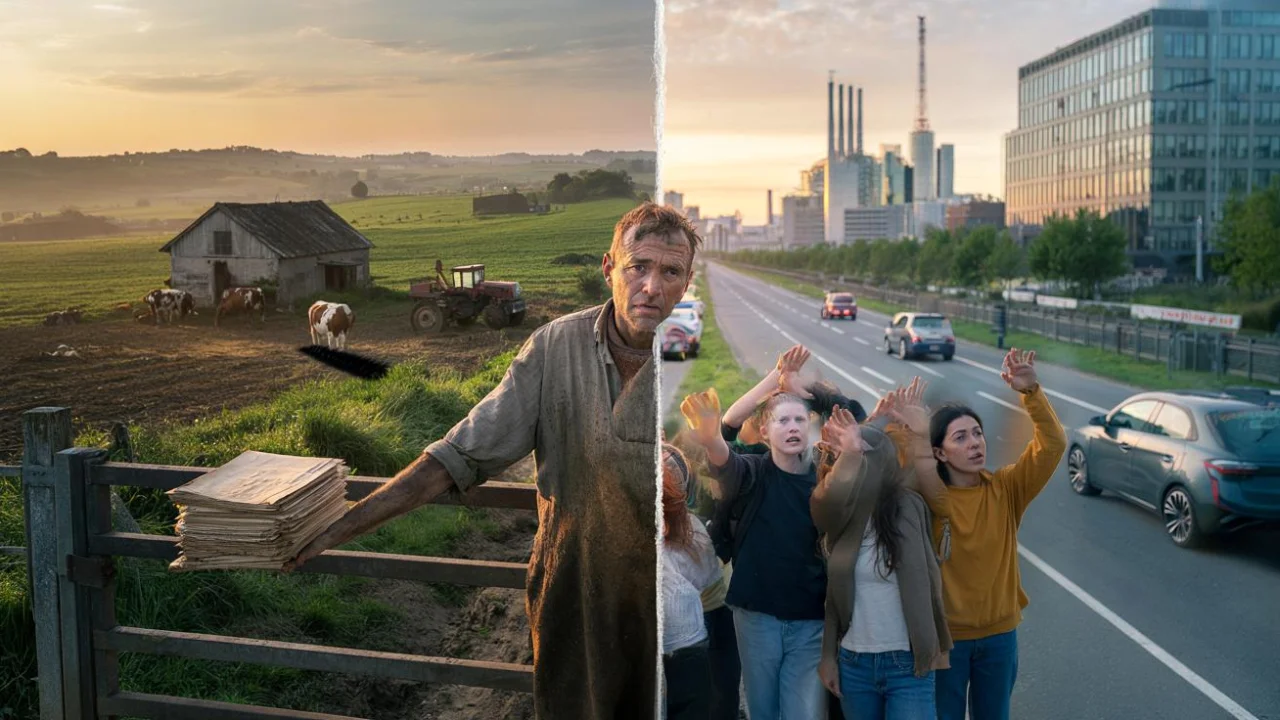
Maria stares at her laptop screen in downtown Portland, watching another video of tractors blocking highways in Europe. She’s been organizing climate protests for three years, sleeping four hours a night, living on instant ramen and righteous anger. The science is clear: we have maybe a decade left to avoid climate catastrophe. Someone needs to change everything, right now.
Three hours east, in Oregon’s wheat country, Tom sits in his kitchen at 5 AM, calculator in one hand, coffee gone cold in the other. New emissions standards just hit. His diesel tractors need expensive retrofits or replacement. The organic certification he’s been working toward for two years? Those rules changed again. His grandfather’s farm might not survive his generation.
Both Maria and Tom care deeply about the planet. Both want their children to inherit a livable world. But climate policies are turning them into enemies, and neither of them chose this fight.
When good intentions create impossible choices
Climate policies sound reasonable in conference rooms: reduce agricultural emissions, transition to sustainable farming, protect water systems. But when these rules hit real communities, they often land like a sledgehammer on people already hanging by a thread.
Farmers face a brutal math problem. New climate regulations require expensive equipment upgrades, reduced fertilizer use that can cut yields by 20-30%, and land set-asides that shrink productive acreage. Meanwhile, extreme weather—the very thing these policies aim to prevent—destroys crops and kills livestock with increasing frequency.
“We’re asked to save the planet with one hand while losing our livelihoods with the other,” says Jake Morrison, a corn and soy farmer from Iowa. “Nobody’s explaining how I feed my family while feeding the world with half the tools I used to have.”
Urban environmental activists, meanwhile, see an existential emergency. Climate science shows agricultural emissions contribute roughly 24% of global greenhouse gases. Every month of delay means worse floods, fires, and food insecurity for everyone.
The hidden costs nobody talks about
The real tragedy isn’t that farmers and environmentalists disagree. It’s that climate policies consistently ask the most vulnerable people to pay the highest price. Here’s what the transition actually looks like on the ground:
| Policy Requirement | Environmental Benefit | Real Cost to Farmers |
|---|---|---|
| Reduce nitrogen fertilizer by 30% | Lower water pollution, less nitrous oxide | 15-25% yield reduction, $50,000+ lost income per farm |
| Upgrade to low-emission tractors | Reduce diesel emissions | $200,000-$500,000 equipment investment |
| Plant buffer strips along waterways | Protect water quality | 10-20% loss of productive farmland |
| Reduce livestock density | Lower methane emissions | Force sale of animals, cut revenue by 40%+ |
Small family farms—often the most sustainable operations—get hit hardest. Large corporate agriculture has lawyers, lobbyists, and enough capital to absorb transition costs. The farmer with 200 acres and three kids in college? That’s who loses the farm.
- Family farms are disappearing at twice the rate they were 20 years ago
- Rural communities lose an average of 50 jobs for every farm that closes
- Young farmers face $1.2 million average startup costs, up 800% since 1980
- Agricultural bankruptcies jumped 24% in states with the strictest environmental regulations
“These policies feel like punishment for doing the job society needs us to do,” explains Sarah Chen, who runs a small organic dairy in Vermont. “We’re feeding people and getting blamed for climate change, then told to fix it with money we don’t have.”
Rural communities caught in the crossfire
The conflict extends far beyond individual farms. Entire rural communities watch their economic foundation crumble in the name of climate action. When family farms fail, local banks, equipment dealers, feed stores, and schools follow.
Rural Americans increasingly see climate policies as urban elites imposing costs on people who can’t afford them. This perception drives political backlash that actually slows climate progress, creating a vicious cycle where environmental urgency generates more environmental resistance.
Dr. Rebecca Martinez, who studies rural sociology at Colorado State University, puts it bluntly: “We’re creating climate policies that pit working-class rural families against working-class urban families. Meanwhile, the corporations that could most easily afford green transitions get subsidies and tax breaks.”
The irony cuts deep. Many farmers already practice regenerative agriculture, capture carbon in soil, and produce food more sustainably than industrial operations. But climate policies often treat all agriculture the same, penalizing small sustainable farms alongside factory operations.
Why this matters beyond farms
This isn’t just about agriculture. The same pattern repeats across climate policy: the costs fall heaviest on people with the least power to absorb them. Auto mechanics whose livelihoods depend on internal combustion engines. Coal miners in towns with no other major employers. Small manufacturers competing against subsidized green alternatives.
Every climate policy creates winners and losers. The question is whether we’ll acknowledge that reality and plan for it, or pretend that saving the planet doesn’t require difficult conversations about who pays and who benefits.
“Climate change is real, and we need aggressive action,” says Marcus Thompson, a former coal worker now organizing for a Green New Deal in West Virginia. “But if we don’t help communities transition, we’ll keep losing political support for the changes we desperately need.”
The stakes couldn’t be higher. Climate science shows we need massive emissions reductions within this decade. But political science shows that policies perceived as unfair or punitive generate backlash that can reverse progress entirely.
Meanwhile, in coffee shops and farm kitchens across the country, people who should be allies in fighting climate change are instead fighting each other over who has to sacrifice first, and how much they can afford to lose for a planet they all want to save.
FAQs
Why do climate policies hit farmers so hard?
Agriculture requires huge upfront investments and operates on thin profit margins, making it difficult to absorb new costs from emissions regulations, equipment upgrades, and land restrictions.
Do urban environmentalists understand rural concerns?
Many genuinely want to help, but urban-rural communication breakdowns and different lived experiences make it hard to find common ground on climate solutions.
Are there climate policies that don’t hurt rural communities?
Yes, but they require more government investment in transition assistance, subsidies for green equipment, and support for communities losing traditional industries.
Why can’t we just move faster on climate change?
Political resistance to climate policies often increases when they create economic hardship, potentially slowing overall progress if communities feel abandoned or punished.
What would fair climate policy look like?
It would spread transition costs more evenly, provide generous support for affected communities, and ensure that wealthy individuals and corporations pay proportional shares.
Is this conflict inevitable?
No, but it requires acknowledging that climate action creates real costs for real people, and planning policies that address both environmental urgency and economic justice.