
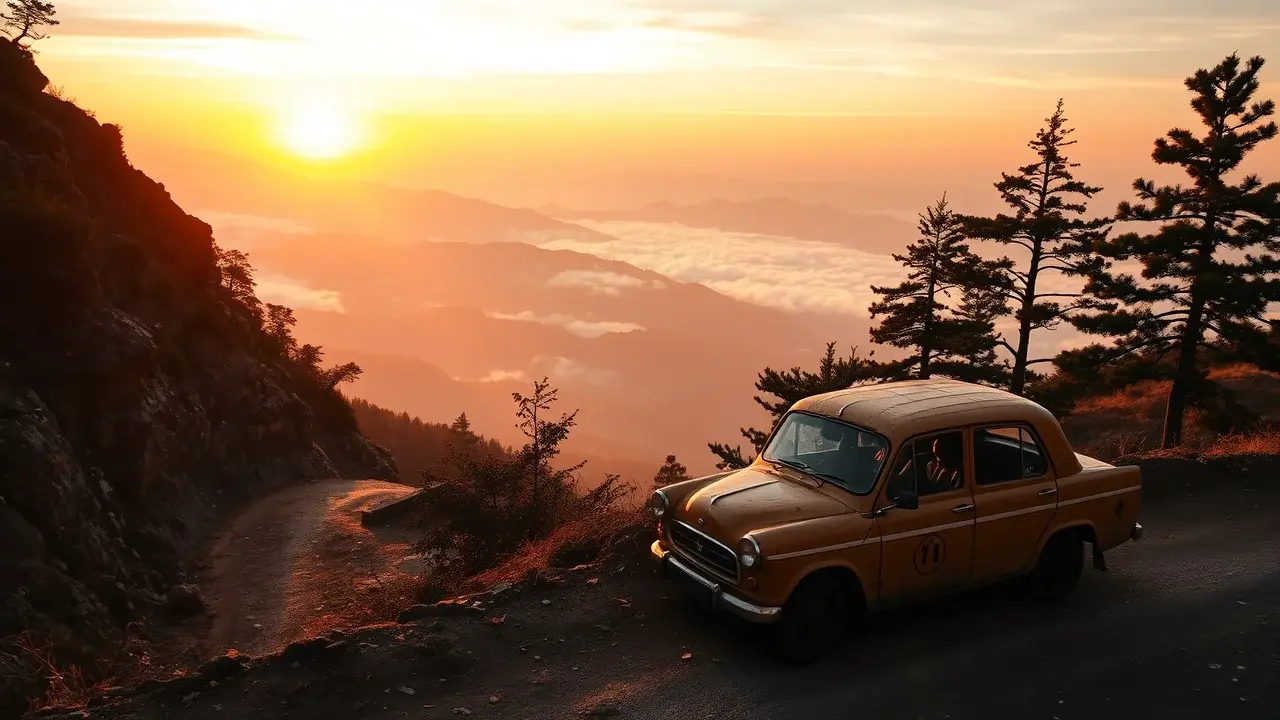
Everyone tells you to watch the sunrise from Gun Hill. Every travel blogger, every hotel brochure, every well-meaning relative who visited Mussoorie in 1998 — they all point you to the same spot. But here is the uncomfortable truth: Gun Hill is one of the most overrated sunrise experiences in the entire Garhwal Himalayas. I say this after standing there at 5:30 AM in October 2023, surrounded by 200 other tourists, a chai vendor playing Bollywood music, and a ropeway operator already setting up for the day. The mountains were beautiful. The experience was not.
Mussoorie’s famous sunrise points are overwhelmed by crowds. This article reveals 7 lesser-known vantage points — with specific directions, best months, and honest tips — where you can actually experience the Himalayan dawn in silence and wonder.
What Are the 7 Hidden Sunrise Points in Mussoorie Most Tourists Miss?
These are seven specific locations within or near Mussoorie that offer extraordinary sunrise views but remain largely unknown to mainstream tourists. According to the Uttarakhand Tourism Development Board’s 2023 visitor data, over 1.5 million tourists visit Mussoorie annually — yet the vast majority cluster around four or five well-known spots. That leaves dozens of ridges, clearings, and forest edges completely empty at dawn.
The seven points I am about to share are not secret in any mystical sense. Local guides know them. Serious trekkers stumble upon them. But they never make it into the glossy pamphlets because they require a little effort, a little early rising, and a willingness to walk more than 200 meters from a parking lot.
Here is a quick comparison of these hidden points versus the popular ones, so you can make an informed choice before you pack your thermos:
| Sunrise Point | Crowd Level | Best Month | Walk Required | Entry Fee |
|---|---|---|---|---|
| Gun Hill (popular) | Very High | Oct–Nov | 0 min (ropeway) | ₹150 ropeway |
| Benog Wildlife Sanctuary Edge | Very Low | Nov–Feb | 25 min | ₹50 forest entry |
| Jabarkhet Nature Reserve | Low | Oct–Dec | 20 min | ₹200 permit |
| Lal Tibba West Ridge | Low–Medium | Sep–Nov | 10 min | Free |
| Clouds End Forest Trail | Very Low | Oct–Mar | 30 min | Free |
| Mossy Falls Upper Ridge | Very Low | Nov–Jan | 40 min | Free |
| Hathipaon Village Clearing | Minimal | Year-round | 15 min | Free |
| Dhanaulti Bypass Meadow | Minimal | Oct–Feb | 5 min | Free |
1. Benog Wildlife Sanctuary Edge — Located about 11 km from Mall Road, this forested ridge faces directly east toward the Bandarpunch and Swargarohini peaks. Arrive by 5:15 AM in winter. The forest department charges ₹50 per person. You will likely be alone.
2. Jabarkhet Nature Reserve Upper Trail — A private conservation reserve near Hathipaon, Jabarkhet opened to eco-tourists in 2017. The upper trail at 2,100 meters offers an unobstructed 180-degree Himalayan panorama. Book a ₹200 dawn permit through their office at +91-135-263-2132 at least a day in advance.
3. Lal Tibba West Ridge — Most tourists crowd the telescope platform at Lal Tibba. Walk 400 meters west along the ridge behind the Doordarshan tower. There is a small clearing with a fallen oak tree. The view of Kedarnath and Badrinath peaks from here in November is genuinely jaw-dropping.
4. Clouds End Forest Trail — The Clouds End Hotel marks the western boundary of Mussoorie. The forest trail behind it winds uphill for 30 minutes to an open knoll. According to the Wildlife Institute of India’s 2022 biodiversity report, this corridor is one of the most ecologically intact forest patches near any Himalayan hill station. Dawn here means birdsong, mist, and zero crowds.
5. Mossy Falls Upper Ridge — Mossy Falls is a small waterfall 7 km from Mussoorie on the Dehradun road. Almost no one walks the trail above the falls. A 40-minute uphill walk brings you to a grassy ridge facing the Doon Valley and the distant Shivalik range. The contrast of valley fog below and golden peaks above is unlike anything at Gun Hill.
6. Hathipaon Village Clearing — Hathipaon is a quiet residential area 5 km from Mall Road. At the far end of the village, past the last guesthouse, a dirt track opens into a small agricultural clearing. Local farmers have watched the sunrise here for generations. The Chaukhamba massif appears directly north on clear October mornings.
7. Dhanaulti Bypass Meadow — Just 3 km before Dhanaulti on the Mussoorie–Chamba road, a small roadside meadow faces the full eastern Himalayan arc. It takes five minutes from your car. Somehow, it remains completely empty at sunrise. The meadow sits at 2,250 meters, above the cloud inversion layer on most winter mornings.
How Does Experiencing a Hidden Sunrise Point Actually Work?
Planning a hidden sunrise experience in Mussoorie is simpler than most people assume. The core logic is this: sunrise in Mussoorie happens between 6:05 AM (June) and 7:10 AM (December), according to the India Meteorological Department’s 2024 sunrise-sunset tables for Uttarakhand. You need to be at your chosen point at least 30 minutes before sunrise to catch the alpenglow — the pink-orange light that hits the high peaks before the sun clears the horizon.
For most of these seven points, that means leaving your hotel by 5:00 AM in winter and 5:30 AM in summer. Carry a headlamp, wear layers (temperatures at these elevations drop to 2–4°C in December and January), and bring a thermos of something warm. A local taxi from Mall Road to Benog or Hathipaon costs approximately ₹300–₹400 for a one-way trip in 2024 rates.
The permit-based points — Jabarkhet and Benog — require a day’s advance planning. For Jabarkhet, call their office or email them directly. For Benog, the forest checkpost opens at 5:00 AM. Arrive on time. The guards are punctual and will not bend rules, which is actually what keeps these places pristine.
Why Does It Matter Where You Watch the Sunrise in Mussoorie?
This question sounds philosophical, but it has a practical answer. The quality of a sunrise experience depends on three variables: the viewing angle relative to the Himalayan peaks, the elevation above the cloud inversion layer, and the absence of artificial light and noise. According to a 2021 study by the Indian Institute of Forest Management on experiential tourism in hill stations, tourists who visited less-crowded natural sites reported 34% higher satisfaction scores than those at popular viewpoints — even when the objective view quality was rated similarly.
Gun Hill sits at 2,024 meters. Several of the seven points I have listed sit above 2,100 meters. That 76-meter difference is often enough to place you above the morning cloud layer that fills the Doon Valley. On those mornings, you watch a sea of white clouds below you while the Himalayan peaks glow gold above. It is a completely different visual experience from watching the same peaks through haze at a lower elevation.
The noise factor matters more than people admit. Birdsong at dawn in a forest has a measurable psychological effect. A 2020 paper published in the journal Landscape and Urban Planning found that natural soundscapes at dawn significantly reduced cortisol levels in study participants compared to urban or semi-urban environments. Mussoorie’s hidden sunrise points are not just prettier — they are genuinely better for your nervous system.
There is also the matter of photography. If you shoot on a phone or a camera, the crowded viewpoints create lens flare from artificial lights, people walking into frame, and the psychological pressure to shoot quickly and move on. At an empty ridge above Hathipaon or on the Clouds End trail, you can set up a tripod, wait for the exact light, and take your time. The photographs are incomparably better.
What Are the Real Benefits of Seeking Out These Hidden Sunrise Points?
The benefits operate on three levels: personal, environmental, and economic. On a personal level, the experience of witnessing a Himalayan sunrise in genuine solitude is something that stays with you for years. I have spoken to travelers who visited Mussoorie a decade ago and still describe a quiet dawn at Benog as the highlight of their entire Uttarakhand trip.
On an environmental level, dispersing tourist footfall matters enormously. Mussoorie receives over 1.5 million visitors annually, according to the Uttarakhand Tourism Development Board. When the vast majority of those visitors concentrate on four or five spots, the ecological damage — soil erosion, litter, disturbance to wildlife — is severe and concentrated. Spreading visitors to lesser-known points reduces pressure on overused areas and helps maintain the ecological health of the entire ridge.
On an economic level, visiting places like Jabarkhet Nature Reserve or hiring a local guide to reach Mossy Falls upper ridge puts money directly into conservation efforts and local households rather than into the pockets of ropeway operators and souvenir stalls. The Jabarkhet reserve, for instance, uses its eco-tourism revenue to fund anti-poaching patrols and habitat restoration, according to their 2023 annual report.
- Complete solitude at dawn
- Better elevation above cloud layer
- Richer natural soundscape
- Stronger photography opportunities
- Lower or zero entry cost
- Supports local conservation
- Memorable, unique experience
- Requires early wake-up (4:30–5 AM)
- Some trails are unmarked
- Limited chai/snack vendors nearby
- Need advance permits for some spots
- Cold temperatures in winter months
- Requires basic fitness for longer walks
The practical implication for any traveler planning a Mussoorie trip is straightforward: build one sunrise morning around a hidden point. You do not have to abandon Gun Hill entirely — visit it in the afternoon for the telescope views and the chai. But give your one precious dawn to a place that will actually move you.
I will leave you with this: the mountains do not care how many people are watching. But you will. Standing alone on a ridge above Hathipaon at 6:10 AM in November, watching Kedarnath peak turn from grey to pink to blazing gold — that is the Mussoorie that exists behind the tourist brochure. It is waiting for anyone willing to wake up 30 minutes earlier and walk 400 meters further than everyone else.
Frequently Asked Questions
What are the best lesser-known sunrise points in Mussoorie?
Mussoorie has several hidden sunrise vantage points beyond the crowded Gun Hill that offer stunning Himalayan views without the tourist rush. These include spots accessible by short treks or drives that most travel guides never mention. The article reveals 7 such locations with specific directions and best visiting months.
Why should I avoid Gun Hill for sunrise in Mussoorie?
Gun Hill attracts hundreds of tourists even at early morning hours, making it a crowded and noisy experience rather than a peaceful Himalayan sunrise. Vendors, ropeway operators, and fellow tourists significantly diminish the natural atmosphere. There are far more serene and equally scenic alternatives within Mussoorie.
What is the best time of year to watch sunrise in Mussoorie?
The clearest Himalayan sunrise views in Mussoorie are typically experienced between October and March when the skies are crisp and free of monsoon haze. October and November are particularly popular for sharp mountain visibility after the rains. Summer months can also offer good views but morning haze is more common.
How do I reach the hidden sunrise points in Mussoorie?
Most of the lesser-known sunrise points in Mussoorie are reachable by a combination of local taxi, walking, or short treks from the main Mall Road area. Specific directions vary by location, and starting before 5 AM is recommended to arrive before sunrise. Hiring a local guide or auto-rickshaw driver familiar with the area can be very helpful.
Is it safe to visit sunrise points in Mussoorie early in the morning?
Mussoorie is generally considered a safe hill station for early morning visits, but it is advisable to go in pairs or small groups when heading to lesser-known spots. Carrying a torch, wearing warm layers, and informing your hotel of your plans adds an extra layer of safety. Sticking to known trails and avoiding isolated paths alone at night is recommended.