
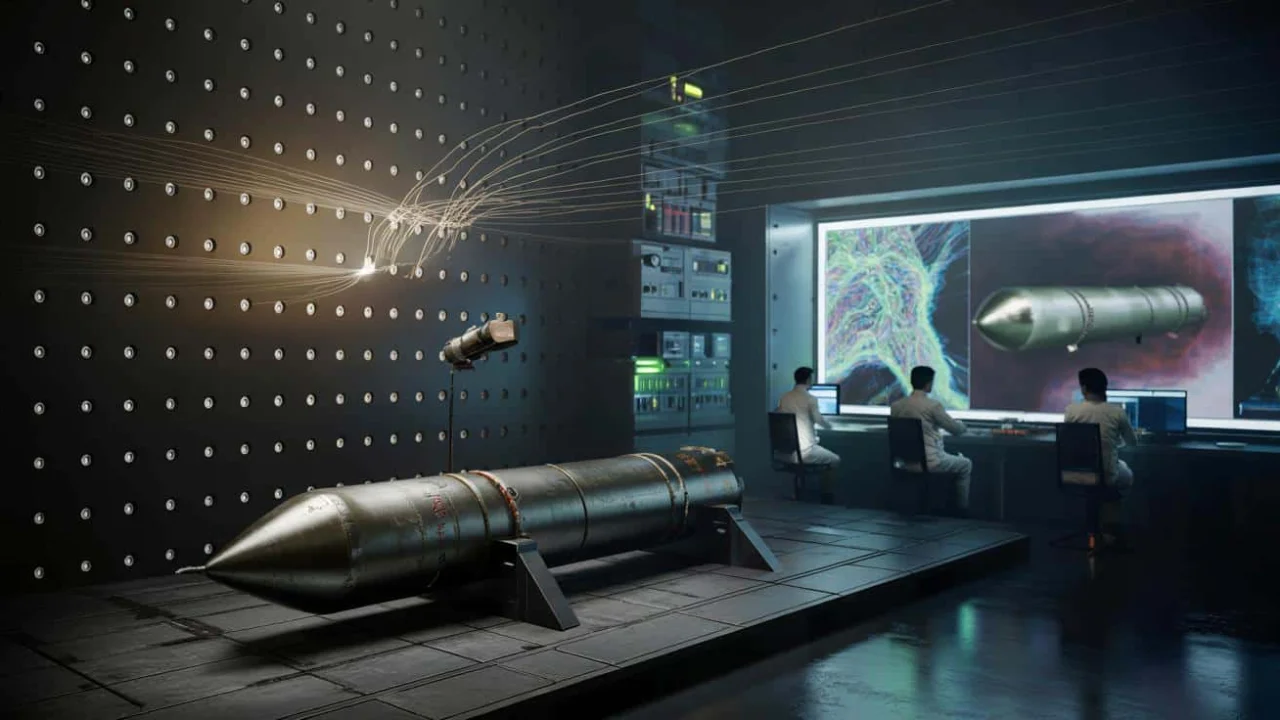
Picture this: you’re a nuclear inspector walking into a heavily guarded facility, tasked with verifying that the warheads lined up before you are real—not clever fakes designed to fool you. Your heart pounds because the wrong call could derail peace negotiations that took years to arrange. For decades, this nightmare scenario has haunted arms control experts worldwide.
Now imagine having an AI assistant that could whisper in your ear: “That one’s real, that one’s a decoy.” It sounds like science fiction, but China claims they’ve made it reality.
This breakthrough in AI nuclear warhead detection could completely reshape how the world handles nuclear weapons. If it works as advertised, we’re looking at the biggest shift in nuclear verification since the first treaty inspections began during the Cold War.
The Decades-Old Problem That’s Been Driving Diplomats Crazy
Here’s the catch-22 that’s plagued nuclear treaties forever: you need to prove your warheads are real to satisfy treaty requirements, but you can’t reveal too much about how they work without giving away state secrets.
Think of it like trying to prove you own a genuine Rolex without letting anyone examine the movement inside. Except instead of losing money, you might lose your entire nuclear deterrent advantage.
Previous verification methods were basically educated guesswork. Inspectors would use radiation detectors and X-ray equipment designed to give just enough information to say “yes” or “no” without revealing weapons design secrets.
“Arms control has always been a tightrope between transparency for verification and secrecy for security,” explains one former nuclear inspector who worked on Soviet-era treaties.
China’s new AI nuclear warhead detection system promises to solve this puzzle by identifying real warheads with remarkable accuracy while keeping sensitive details completely hidden.
How China’s Game-Changing AI Technology Actually Works
The system developed at the China Institute of Atomic Energy isn’t trying to peek inside warheads like a medical X-ray. Instead, it’s reading the unique “fingerprint” that different materials leave when neutrons pass through them.
Here’s how the detection process breaks down:
- Neutron bombardment: The AI system fires streams of neutrons at the object being inspected
- Material signatures: Each material (uranium, plutonium, steel, lead) interacts with neutrons differently
- Pattern recognition: Advanced algorithms analyze how neutrons scatter and get absorbed
- Real vs. fake determination: The AI compares patterns against millions of simulated scenarios
The training process involved feeding the AI countless computer simulations of everything from authentic warhead assemblies to sophisticated decoys made from dense metals designed to fool traditional detection methods.
| Detection Method | Accuracy Rate | Information Revealed | Security Risk |
|---|---|---|---|
| Traditional X-ray | 60-70% | Basic density maps | Medium |
| Radiation scanning | 75-80% | Isotope presence | Low |
| China’s AI system | 95%+ (claimed) | Minimal structural data | Very low |
“By comparing neutron patterns against vast simulated datasets, the AI can flag whether an inspected item behaves like a real warhead core or an elaborate fake,” notes a nuclear physics researcher familiar with the technology.
What This Means for Your Safety and Global Security
If China’s AI nuclear warhead detection system proves reliable, we’re looking at a fundamental shift in how nuclear powers interact with each other. The implications ripple out far beyond the inspection room.
For everyday people, this could mean more effective arms control treaties. When countries can verify each other’s nuclear arsenals without revealing sensitive secrets, they’re more likely to actually reduce their weapons stockpiles.
The technology could impact several key areas:
- Nuclear disarmament talks: Easier verification could unlock stalled negotiations
- Proliferation prevention: Better detection of illegal nuclear programs
- Treaty compliance: More accurate monitoring of existing agreements
- Global stability: Reduced uncertainty about other nations’ capabilities
But there’s a flip side. Other nuclear powers might rush to develop their own AI detection systems, potentially triggering a new kind of technological arms race.
“This invention could either stabilize nuclear relations by building trust, or destabilize them by making everyone paranoid about what the other side can detect,” warns a former State Department arms control negotiator.
The Skeptics Have Valid Concerns
Not everyone’s convinced that China’s AI breakthrough will work as advertised in real-world conditions. Computer simulations are one thing—actual warheads with decades of modifications and variations are another entirely.
The technology also raises uncomfortable questions about nuclear transparency. If one country develops superior detection capabilities, does that give them an unfair advantage in negotiations?
Some experts worry that widespread adoption of AI nuclear warhead detection could actually make the world less safe by encouraging countries to develop more sophisticated decoys or abandon treaties altogether.
“The nuclear balance depends partly on uncertainty,” explains a nuclear policy analyst at a major think tank. “When you remove too much uncertainty, you might destabilize deterrence itself.”
What Happens Next Could Shape the Next Decade
China’s timing isn’t coincidental. With the US and Russia locked in increasingly hostile relations, and new nuclear powers like North Korea advancing their capabilities, effective verification technology has never been more crucial.
The next few years will likely see intense international scrutiny of China’s claims. Independent verification by neutral parties will be essential before any country trusts this technology for actual treaty monitoring.
Meanwhile, expect other nuclear powers to accelerate their own AI research programs. Nobody wants to fall behind in this particular technological race.
The success or failure of AI nuclear warhead detection systems could determine whether we enter a new era of nuclear cooperation or spiral into deeper mutual suspicion. Either way, the old rules of the nuclear game are clearly changing.
FAQs
How accurate is China’s AI nuclear warhead detection system?
China claims over 95% accuracy in laboratory conditions, though this hasn’t been independently verified in real-world scenarios.
Could other countries steal this technology?
While the basic principles are known, replicating the specific AI algorithms and training data would require significant resources and expertise.
Will this technology make nuclear weapons obsolete?
No, but it could make hiding illegal nuclear programs much more difficult and encourage more transparent disarmament processes.
When might we see this AI system used in actual treaty inspections?
International adoption would likely take years of testing and diplomatic negotiations, assuming the technology proves reliable.
What prevents countries from developing better decoys to fool the AI?
The AI was trained on sophisticated decoy attempts, but there’s always potential for an arms race between detection and deception technologies.
Does this give China an unfair advantage in nuclear negotiations?
Potentially, though sharing the technology with international monitoring agencies could level the playing field for verification purposes.