
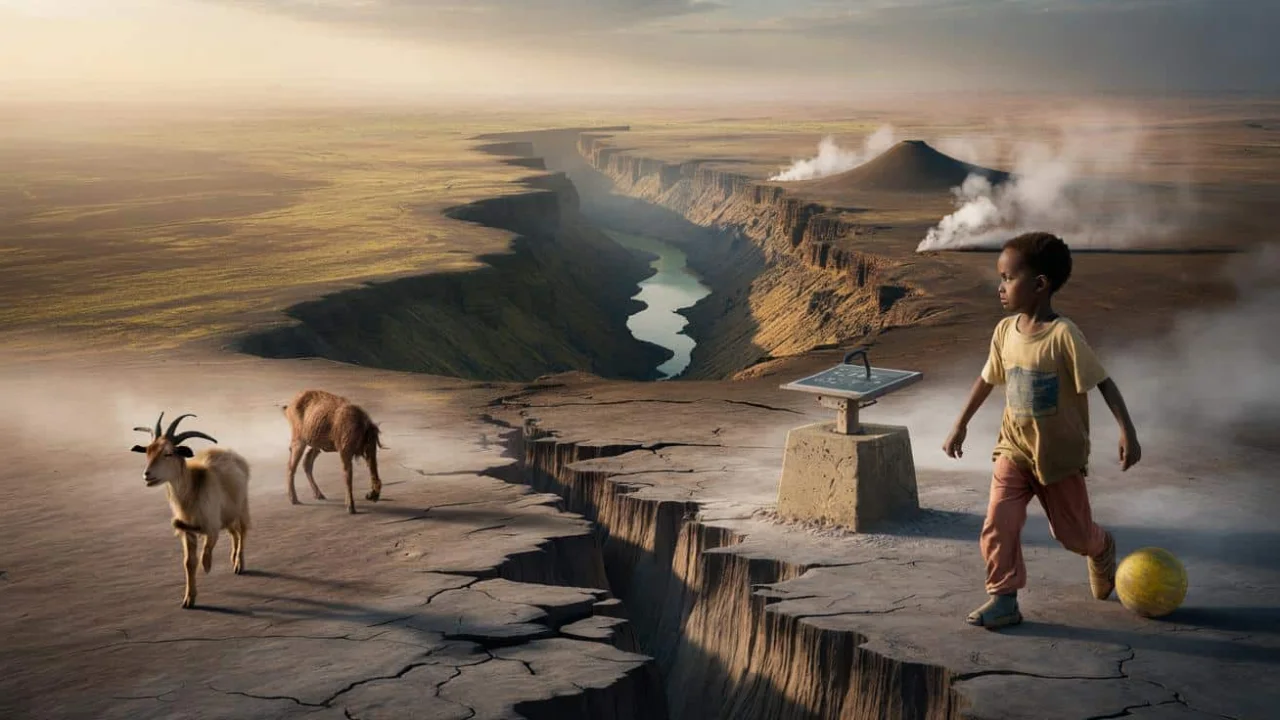
Last year, a farmer in Kenya woke up to find his maize field sliced in half by a crack wider than his arm span. He called his neighbor, then the local radio station, and by evening, photos of the dramatic fissure were spreading across social media. “The earth just opened up overnight,” he told reporters, pointing at the jagged line that had swallowed part of his crop.
What he didn’t know was that his farm sits right on top of one of geology’s most spectacular ongoing shows. The crack wasn’t really sudden—it was the latest visible sign of something that’s been building for millions of years and continues every single day.
The Africa tectonic split is happening right now, measured in real-time by satellites and GPS stations across the continent. While the dramatic changes won’t be complete for another 5 to 10 million years, the process is already detectable and accelerating.
The slow-motion breakup that’s already underway
You can’t feel it when you’re walking around Nairobi or Addis Ababa, but Africa is literally stretching apart. The East African Rift System runs like a giant zipper from the Red Sea down through Ethiopia, Kenya, Tanzania, and beyond—and that zipper is slowly opening.
“We can measure the continent moving apart by about 6 to 7 millimeters per year in some places,” explains Dr. Sarah Chen, a geophysicist who studies continental rifting. “That might sound tiny, but in geological terms, it’s remarkably fast.”
The rift system isn’t just one clean break. It’s actually two main branches that split around Lake Victoria and rejoin further south, creating what scientists call the East African Rift Valley. This area is home to some of the world’s most famous landmarks—Mount Kilimanjaro, the Serengeti, and the lakes where early human fossils were discovered.
Modern technology has revealed just how active this process really is. GPS stations anchored deep in bedrock track tiny movements that add up over time. Satellite radar can detect ground changes as small as a few millimeters. Even more telling, the rift zone experiences thousands of small earthquakes each year—most too small to feel, but clear evidence that the crust is under constant stress.
What the numbers tell us about continental divorce
The data coming from Africa’s tectonic monitoring network paints a clear picture of a continent in transition. Here’s what scientists are measuring right now:
| Location | Annual Movement Rate | Key Features |
|---|---|---|
| Afar Triangle (Ethiopia) | 15-20 mm/year | Active volcanism, below sea level |
| Kenya Rift Valley | 3-5 mm/year | Lakes, frequent small earthquakes |
| Tanzania/Malawi region | 2-4 mm/year | Deep rift lakes, volcanic activity |
| Red Sea expansion | 16 mm/year | New oceanic crust forming |
The measurements show that different parts of the rift are moving at different speeds. The fastest action happens in the Afar region of Ethiopia, where three tectonic plates meet in what geologists call a “triple junction.” Here, the African plate is being pulled apart by the Arabian and Nubian plates.
“The Afar Triangle is like a preview of what the entire rift system will look like millions of years from now,” notes Dr. James Mukuru, a Kenyan geologist. “Parts of it are already below sea level, and if it weren’t for the highlands blocking it, seawater would rush in tomorrow.”
The process creates distinctive geological signatures that scientists can track:
- Volcanic activity concentrates along the rift edges
- Deep, narrow lakes form in the stretched crust
- Frequent swarms of small earthquakes
- Hot springs and geothermal features
- Distinctive flora and fauna in isolated rift valleys
Living on a continent that’s coming apart
For the 200 million people who live along the East African Rift, the tectonic split isn’t an abstract scientific concept—it’s part of daily life. The region’s unique geology creates both opportunities and challenges that affect millions of families.
The rift’s volcanic activity provides some of the world’s most fertile soil. The highlands of Kenya and Ethiopia produce coffee that feeds global markets, while the mineral-rich soils support agriculture that feeds local populations. Geothermal energy from the tectonic activity powers parts of Kenya and could provide clean energy for much of East Africa.
But living on an active continental rift also means dealing with regular earthquakes, volcanic eruptions, and ground instability. The 2018 crack in Kenya’s Narok County that went viral was just one of hundreds of similar features that appear each year across the region.
“My grandmother always said the land here was restless,” shares Mary Wanjiku, who farms near Kenya’s Suswa volcano. “Now I understand what she meant. The ground shakes, new cracks appear, and sometimes the hot springs change temperature overnight.”
The long-term implications are staggering to consider. If current rates continue, eastern Africa—including countries like Somalia, parts of Kenya, Ethiopia, and Tanzania—will eventually separate from the rest of the continent. The Indian Ocean will flood into the rift valleys, creating a new sea that could be larger than the Mediterranean.
Cities like Nairobi and Addis Ababa sit right on the edge of this future geological boundary. While they won’t see dramatic changes in our lifetimes, the ongoing tectonic activity influences everything from urban planning to infrastructure development.
The bigger picture of our changing planet
Africa’s tectonic split represents more than just continental geology—it’s a window into how our planet continuously reshapes itself. The same forces pulling Africa apart have created and destroyed oceans throughout Earth’s history.
“What we’re witnessing in East Africa is how the Atlantic Ocean started 200 million years ago,” explains Dr. Chen. “Every ocean begins as a continental rift. Africa is showing us planetary evolution in real-time.”
The measurements coming from Africa also help scientists understand similar processes happening elsewhere. The technology developed to track the Africa tectonic split is now used to monitor active rifts in other parts of the world, from Iceland to the western United States.
Climate change adds another layer of complexity to the story. As rainfall patterns shift across East Africa, the erosion and surface processes that make tectonic features visible are also changing. The dramatic cracks that occasionally appear after heavy rains—like the one that made headlines in 2018—might become more or less common depending on future precipitation patterns.
FAQs
Will Africa actually split in half during our lifetime?
No, the complete separation will take 5 to 10 million years, though we can already measure the continent moving apart by millimeters each year.
Is the splitting process dangerous for people living in East Africa?
The gradual rifting itself isn’t dangerous, but it does cause earthquakes and volcanic activity that can affect local communities.
How do scientists measure something that moves so slowly?
GPS stations and satellite technology can detect movements as small as a few millimeters per year, allowing precise tracking of tectonic motion.
What will happen to the countries along the rift when Africa splits?
Eventually, parts of countries like Kenya, Ethiopia, and Somalia would become a separate landmass, but this process will take millions of years.
Are there any benefits to living on an active continental rift?
Yes, the geological activity creates fertile volcanic soils, geothermal energy sources, and unique ecosystems that support local economies.
Could the splitting process speed up or slow down?
The rate is generally consistent over geological time, though it varies by location within the rift system based on local tectonic forces.