
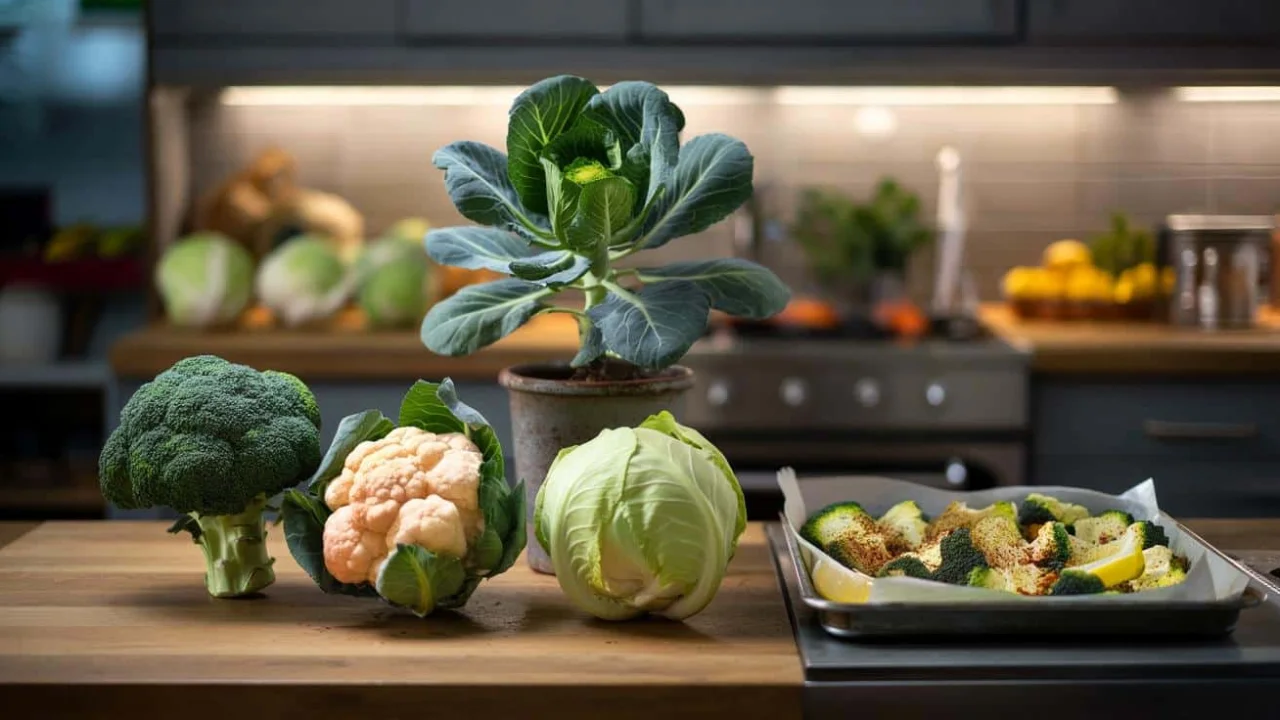
Last Tuesday at the grocery store, I watched a woman stand frozen between three vegetables that seemed to mock her dinner plans. She picked up a head of broccoli, then cauliflower, then cabbage, rotating them like she was solving a puzzle. Her cart already held chicken and rice, but these three green and white options felt like they belonged in completely different meals.
She finally grabbed the broccoli and hurried away, probably thinking she’d made three separate decisions about three unrelated plants.
If only she knew the truth that would have simplified her choice entirely.
The family secret hiding in your produce aisle
Here’s something that still surprises most people: cauliflower, broccoli, and cabbage aren’t different plants at all. They’re all varieties of the same species, Brassica oleracea. Think of them as siblings who look nothing alike but share the exact same parents.
This wild plant originally grew along rocky coastlines around the Mediterranean and Atlantic regions. Over thousands of years, farmers selectively bred different parts of this single plant to create what we now see as completely separate vegetables.
“Most people assume these are different species because they look so different,” says Dr. Sarah Chen, a botanist at the University of California. “But genetically, they’re nearly identical. We just emphasized different plant parts through selective breeding.”
With cabbage, farmers encouraged the leaves to form tight, dense heads. For broccoli, they selected plants with large, clustered flower buds. Cauliflower represents the most extreme transformation—dense, white flower heads that never fully open.
Meet the entire Brassica oleracea family tree
The family is actually much larger than just these three popular vegetables. The complete list of Brassica oleracea varieties will shock you:
- Cabbage (var. capitata) – tight leaf heads
- Broccoli (var. italica) – flowering shoots
- Cauliflower (var. botrytis) – dense white flower heads
- Brussels sprouts (var. gemmifera) – miniature cabbage-like buds
- Kale (var. acephala) – loose, curly leaves
- Kohlrabi (var. gongylodes) – swollen stem base
- Collard greens (var. viridis) – flat, broad leaves
Each variety represents humans selecting for different plant characteristics over centuries. Brussels sprouts focus on tiny leaf buds along the stem. Kale emphasizes large, nutritious leaves. Kohlrabi develops an enlarged stem that tastes like a cross between cabbage and turnip.
| Variety | Plant Part Emphasized | Breeding Focus | First Cultivated |
|---|---|---|---|
| Cabbage | Leaves | Dense, tight heads | 600 BCE |
| Broccoli | Flower buds | Large, clustered florets | 6th century |
| Cauliflower | Flower heads | White, dense clusters | 12th century |
| Brussels Sprouts | Leaf buds | Mini cabbage formation | 13th century |
| Kale | Leaves | Large, nutritious foliage | 2000 BCE |
“What’s fascinating is that this diversification happened relatively recently in plant evolution terms,” explains Dr. Michael Rodriguez, a plant geneticist. “These varieties have only been separate for a few thousand years, which is nothing in botanical time.”
Why this changes everything about cooking and nutrition
Understanding that these are all Brassica oleracea varieties transforms how you approach cooking and meal planning. They share similar nutritional profiles, cooking behaviors, and flavor foundations.
All these vegetables are nutritional powerhouses with similar benefits:
- High in vitamin C and vitamin K
- Rich in fiber and antioxidants
- Contain sulforaphane, a cancer-fighting compound
- Low in calories but high in nutrients
- Natural detoxification support
This means if you love roasted broccoli, you’ll probably enjoy roasted cauliflower or Brussels sprouts prepared the same way. The cooking methods that work for one variety often work beautifully for the others.
“Once people realize they’re cooking the same plant in different forms, they become much more adventurous,” says chef Maria Santos, who specializes in vegetable-forward cuisine. “The fear of unfamiliar vegetables disappears when you understand the family connection.”
The practical magic of knowing your Brassicas
This knowledge becomes incredibly useful for several reasons. First, seasonal availability means you can substitute one variety for another in most recipes. When broccoli prices spike in winter, cauliflower or cabbage can often fill the same role.
Second, if you’re trying to eat more vegetables but feel stuck in a rut, knowing these are related gives you permission to experiment. Love cabbage in coleslaw? Try raw cauliflower or broccoli stalks the same way.
Storage and preparation methods are also similar across the family. They all prefer cool, humid conditions and benefit from similar washing and prep techniques.
“The beauty is that mastering one variety gives you insight into cooking all of them,” notes Dr. Chen. “They respond to heat, seasoning, and preparation methods in very similar ways.”
Even growing them follows similar patterns. These vegetables prefer cool weather, rich soil, and consistent moisture. Home gardeners often find that success with one variety translates to success with the others.
FAQs
Are cauliflower, broccoli, and cabbage really the same plant?
Yes, they’re all varieties of Brassica oleracea, selectively bred over thousands of years to emphasize different plant parts.
Can I substitute one for another in recipes?
Often yes, especially in roasted, sautéed, or raw preparations, though cooking times may vary slightly due to density differences.
Do they all have the same nutritional value?
They’re very similar nutritionally, all being high in vitamin C, fiber, and beneficial compounds, with minor variations in specific nutrients.
Why do they taste different if they’re the same plant?
Different plant parts (leaves, flower buds, stems) naturally have different textures and concentrated flavors, even from the same genetic base.
What other vegetables are in this family?
Brussels sprouts, kale, kohlrabi, and collard greens are also Brassica oleracea varieties, making it a family of seven common vegetables.
When did these varieties first develop?
Kale is the oldest (around 2000 BCE), while Brussels sprouts are relatively recent (13th century), showing how humans continued breeding new varieties over time.