
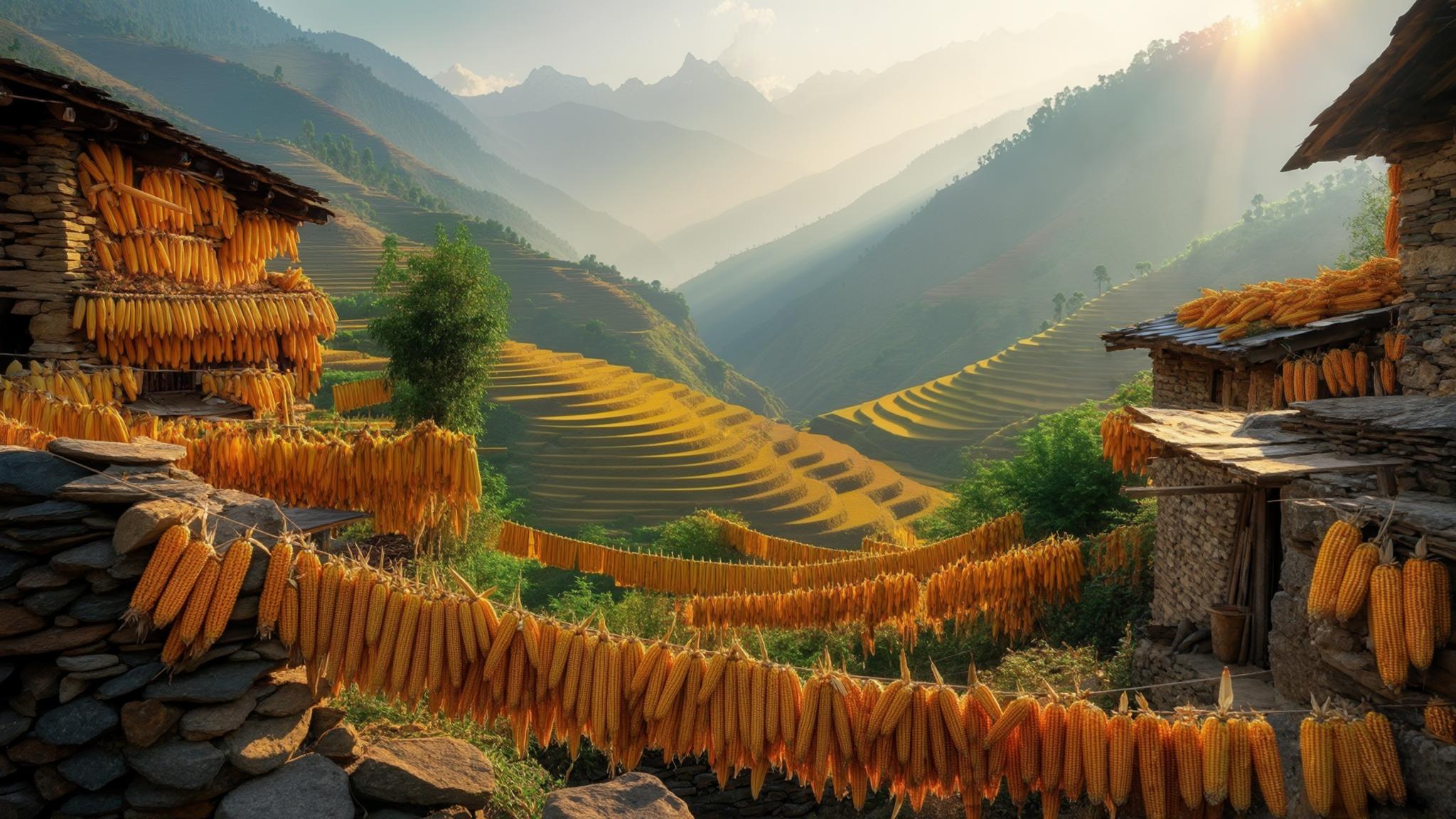
When did a food staple become the most visible symbol of a community’s identity — and why has no one outside a 10-kilometre radius heard about it? That question sits at the heart of Sainji Village, a quiet hamlet in Uttarakhand’s Tehri Garhwal district that has, for generations, turned its own harvest into living architecture.
Every year, as the corn season peaks, residents of Sainji hang hundreds of peeled corn cobs along the facades of their homes. The bright yellow-orange garlands transform stone-and-timber walls into something that resembles a harvest installation. Tourists arriving from nearby Mussoorie — most of whom are unaware the village exists — often stop on the road simply because the visual is so unexpected.
What Actually Happens in Sainji — and Why the Corn Is There
The practice is both functional and symbolic. According to Times of India’s feature on Sainji, villagers peel corn ears and hang them outside their homes in large, dense clusters. The practice serves as a natural drying and storage method — the mountain air and sunlight cure the corn without modern equipment — but the ritual dimension is equally significant.
The corn garlands are not tucked away in storage areas or hung discreetly. They face outward, toward the road, toward visitors, toward the valley below. Residents and observers have noted that the deliberate display signals community continuity — a visible affirmation that the village remains connected to its agricultural roots even as modernisation reaches the lower slopes of the Garhwal hills.
The timing of the display aligns with the post-harvest season, typically between August and October, when the cobs are freshest and the display is at its most vivid. By winter, the dried corn is taken down and used — completing a cycle that has repeated itself across generations without interruption.
The Geography: How Close Is Sainji to Mussoorie, and How Do You Get There
Sainji sits roughly 10 kilometres from Mussoorie on a route that most visitors travelling between the hill station and the Tehri region pass without stopping. The road access is manageable by car or motorcycle, though the final approach involves narrower mountain roads typical of Garhwal villages at this elevation.
From Mussoorie’s Library Bus Stand, travellers can take shared jeeps or taxis toward the Kempty Falls–Nainbagh corridor, from which Sainji is accessible via a short detour. Private taxi hire from Mussoorie for a half-day visit to Sainji and back costs approximately ₹800 to ₹1,200 depending on the vehicle and negotiation, based on typical Mussoorie–Tehri route fares. No dedicated tourist shuttle currently operates to the village.
The village is not signposted prominently from the main road, which means first-time visitors are advised to confirm directions locally before departure. Residents in Mussoorie’s Landour area are generally familiar with the route.
What Sainji Offers Beyond the Corn: Ecotourism and Cultural Depth
The corn display is the most photographed aspect of Sainji, but it is not the only draw. According to research compiled about the village, Sainji functions as a multi-layered ecotourism destination that combines birdwatching, sustainable agriculture observation, and cultural immersion in a single compact location.
- Birdwatching: The surrounding forest and agricultural land attract a variety of Himalayan bird species, making the area of interest to birders who find Mussoorie’s central zones too crowded and noisy for serious observation.
- Sustainable agriculture: Corn cultivation in Sainji is carried out using traditional methods largely unchanged by industrial farming practices. Visitors can observe terraced fields and speak with farming families about crop cycles.
- Cultural engagement: The village represents a living example of Garhwali heritage practices. Unlike reconstructed folk museums, the traditions here are actively maintained by the resident community rather than preserved for display.
- Photography: The combination of stone architecture, mountain backdrops, and the corn-draped facades creates a visual environment that has attracted travel photographers seeking alternatives to Mussoorie’s overcrowded viewpoints.
The Broader Context: Why Villages Like Sainji Matter to Uttarakhand’s Tourism Identity
Mussoorie receives millions of visitors annually, the majority of whom concentrate on the Mall Road, Kempty Falls, and Lal Tibba viewpoint. The surrounding villages — many of which preserve traditions, architecture, and ecological practices that the hill station itself has long since traded for hotels and souvenir shops — remain largely outside the formal tourism economy.
Sainji represents a category of destination that Uttarakhand’s tourism planners have begun to describe under the broader ecotourism and rural heritage framework. According to the Uttarakhand Tourism Development Board’s stated policy direction, village tourism circuits are intended to distribute visitor footfall beyond primary hotspots and generate income for communities in Tehri Garhwal and Pauri Garhwal districts that currently see minimal tourism revenue.
The question of whether villages like Sainji can sustain increased visitor interest without losing the very qualities that make them worth visiting is one that Uttarakhand’s tourism administrators have not fully resolved. For now, Sainji remains small enough that the balance holds — a village that welcomes observers without yet being reshaped by them.
For travellers staying in Mussoorie who have exhausted the hill station’s primary attractions, Sainji offers something that no cable car ride or viewpoint café can replicate: a direct encounter with a living practice, maintained not for tourism but in spite of it.
Frequently Asked Questions
{“@context”:”https://schema.org”,”@type”:”FAQPage”,”mainEntity”:[{“@type”:”Question”,”name”:”Where exactly is Sainji Village located?”,”acceptedAnswer”:{“@type”:”Answer”,”text”:”Sainji Village is located in Tehri Garhwal district, Uttarakhand, approximately 10 kilometres from Mussoorie, along the route toward the Kempty Falls and Nainbagh corridor.”}},{“@type”:”Question”,”name”:”Why do villagers in Sainji hang corn outside their homes?”,”acceptedAnswer”:{“@type”:”Answer”,”text”:”According to Times of India, the practice combines a traditional grain-drying and storage function with a cultural expression of heritage identity. Villagers hang hundreds of peeled corn cobs along their home facades each harvest season — a practice maintained for generations.”}},{“@type”:”Question”,”name”:”When is the best time to visit Sainji Village to see the corn displays?”,”acceptedAnswer”:{“@type”:”Answer”,”text”:”The peak display period is August to October, immediately following the corn harvest. Outside this season, the village is accessible but the corn garlands are not present.”}},{“@type”:”Question”,”name”:”How much does it cost to travel from Mussoorie to Sainji Village?”,”acceptedAnswer”:{“@type”:”Answer”,”text”:”A private taxi from Mussoorie’s Library Bus Stand for a return half-day trip costs approximately ₹800 to ₹1,200 based on standard local route fares. Shared jeeps toward Nainbagh offer a lower-cost alternative.”}},{“@type”:”Question”,”name”:”What activities are available in Sainji beyond the corn-decorated homes?”,”acceptedAnswer”:{“@type”:”Answer”,”text”:”Sainji is documented as offering birdwatching in surrounding forested areas, observation of traditional terraced agriculture, cultural engagement with Garhwali heritage practices, and landscape photography — making it a compact ecotourism destination.”}}]}